Last Updated on 27 Oct 2026 by Pippo Ardilles
At origin in Indonesia, wholesale kopi luwak costs about USD 50–78 per kg, roughly ₹4,800–7,500 per kg or ₹480–750 per 100 g. Imported packs on Indian shelves cost several times more. Coffee imports carry a 100% basic customs duty, or 45% for ASEAN origins such as Indonesia, plus GST, freight, and retail margin.
This guide converts each stage to rupees so Indian buyers can see where the price comes from. For global retail and wholesale benchmarks, see our main kopi luwak price guide.
How Much Does Kopi Luwak Cost in India?
The price you pay in India depends on the stage at which you buy. The same coffee is valued very differently at origin, after import, and in a retail tin.
| Stage | Price | Per 100 g (approx.) |
|---|---|---|
| Indonesian origin, wholesale (FnB Coffee) | USD 50–78/kg, about ₹4,800–7,500/kg | ₹480–750 |
| Global retail benchmark, roasted | USD 100–600/lb, about ₹21,000–1,27,000/kg | ₹2,100–12,700 |
| Civet coffee grown in Coorg, India (reported 2020) | ₹900 per 100 g bag | ₹900 |
Rupee figures use about ₹96 per US dollar and move with the exchange rate. The origin price excludes freight, duty, and GST; where kopi luwak comes from also shapes the price.
Why Imported Kopi Luwak Costs More in India
Three costs sit between the origin price and the price on an Indian shelf: import duty, food-safety clearance, and the margin on small retail packs.
Import Duty on Coffee: 100% or 45%
India charges a basic customs duty of 100% plus 5% IGST on green coffee from most countries. Under the ASEAN–India Free Trade Agreement, coffee from ASEAN members, including Indonesia, has had a preferential rate of 45% since the end of 2019.
The preferential rate needs a valid AIFTA certificate of origin, so ask your exporter for it before shipment. Here is the effect on coffee valued at an illustrative ₹6,000 per kg:
| Duty route | Basic customs duty | IGST (5%) | Value after duty and IGST |
|---|---|---|---|
| Standard rate (100%) | ₹6,000 | ₹600 | about ₹12,600 |
| AIFTA rate (45%) | ₹2,700 | ₹435 | about ₹9,135 |
This is a simplified example before freight and other levies. Confirm the exact rate and HS code with your customs broker.
Food Safety and Plant Quarantine Clearance
Coffee is a regulated food import in India. Importers need an FSSAI import licence, compliant labelling, and plant quarantine clearance, which supports a phytosanitary certificate from the exporter. Each step adds time and handling cost.
Freight, Repacking, and Retail Margin
Small retail packs inflate the per-kilogram figure. A ₹1,500 tin of 100 g is really ₹15,000 per kg once converted. Freight, repacking, storage, and platform fees all sit inside that number.
Wild, Farmed, and Indian-Grown Kopi Luwak
How the beans were produced moves the price more than any other factor. Indian buyers will see three kinds on the market.
Wild-Sourced Kopi Luwak
Beans come from free-roaming civets and are collected on foot, so volumes are small and seasonal. This is the most expensive tier and the one most often faked.
Farmed or Caged Kopi Luwak
Civets are kept in enclosures and fed cherries, which raises output and lowers cost. Welfare standards vary widely, and caged coffee is often sold as “wild”. Our comparison of wild vs caged civet coffee explains the difference.
Civet Coffee from Coorg
India has its own small civet coffee production in Coorg, Karnataka, where wild civets visit the coffee estates. It avoids import duty, which is why it can sell below imported tins.
How to Check a Kopi Luwak Price Before You Buy
A low price is only a bargain if the coffee is real. Before you pay, check that the seller can show:
- The price per kg, with the format stated (beans or ground)
- The origin region and whether it is wild or farmed
- A roast date, not only a best-before date
- An FSSAI licence number on the label of imported packs
- A cupping report or lot reference for larger orders
“Wild” kopi luwak priced close to ordinary specialty coffee is a warning sign. Our guide on how to identify real kopi luwak covers the checks in detail.
Which Format Should You Buy?
The format changes both the price and how long the coffee stays fresh.
Whole Roasted Beans
Whole beans keep their aroma longest and suit home grinders and cafés. They are the best choice when you are paying a premium.
Ground Coffee
Ground coffee is convenient but goes stale faster once opened. Buy small packs and use them within a few weeks.
Green Beans for Roasters
Green beans are the cheapest per kilogram and keep longest. They suit Indian roasters who want to control the roast profile themselves.
Buying Kopi Luwak in Bulk for a Café or Roastery
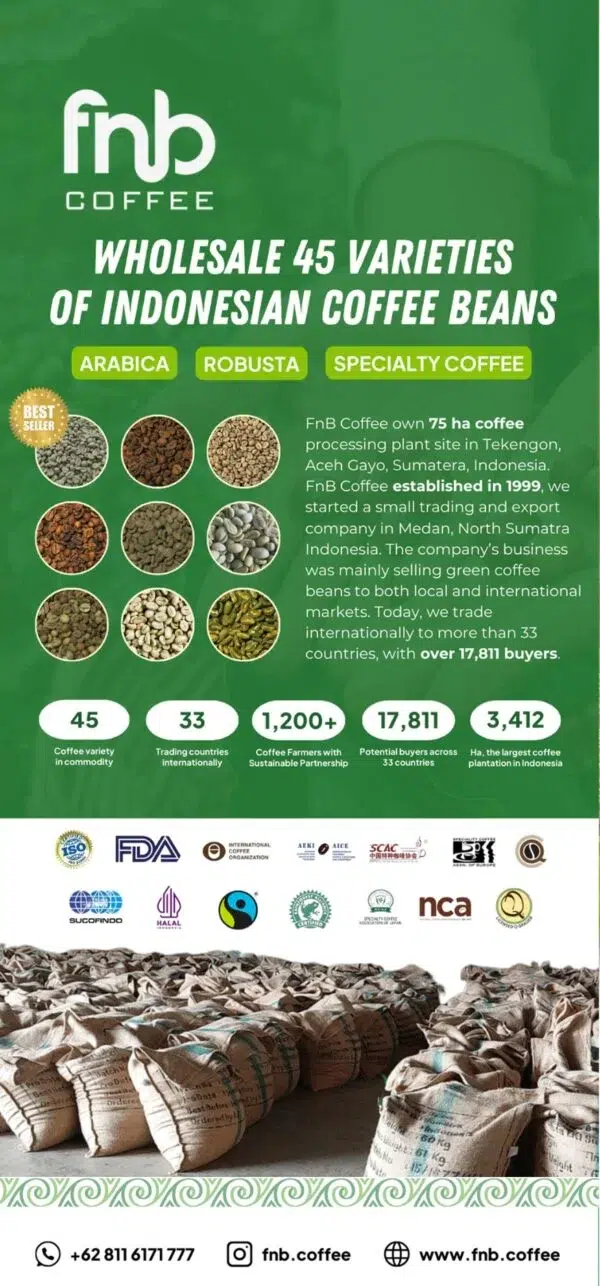
Buying direct from origin removes the reseller layers that make retail tins expensive. FnB Coffee supplies green, roasted, and ground kopi luwak from Sumatra, Java, and Bali, at USD 50–78 per kg indicative.
Orders start at a USD 100 minimum, and a 350 g sample from the actual lot ships before you commit. Each shipment comes with a Certificate of Origin and a Phytosanitary Certificate. To plan an import into India, request a kopi luwak quote from Indonesia and mention that you plan to claim the AIFTA duty rate.
FAQ
1. How much does kopi luwak cost in India?
At Indonesian origin it costs about ₹4,800–7,500 per kg wholesale (USD 50–78). Imported retail packs cost far more once duty, GST, freight, and margin are added.
2. What is the import duty on coffee in India?
The standard basic customs duty on coffee is 100%, plus 5% IGST. Coffee from ASEAN countries such as Indonesia qualifies for 45% under the ASEAN–India FTA with a valid certificate of origin.
3. Why is imported kopi luwak so expensive in India?
The coffee is scarce at origin, and import duty roughly doubles its landed value at the standard rate. Small retail packs then add margin on top.
4. Is there kopi luwak produced in India?
Yes. A small amount of civet coffee is produced in Coorg, Karnataka. It avoids import duty, so it can sell below imported kopi luwak.
5. Can an Indian café buy kopi luwak directly from Indonesia?
Yes, if the importer holds an FSSAI import licence and clears plant quarantine. Buying at origin removes reseller layers, and the AIFTA rate lowers the duty.