
Last Updated on 12 Jun 2026 by Tania Putri
So, you’ve invested in quality beans, maybe even a bag of single-origin Sumatra Arabica, and you’ve brewed your first cup. But something still feels off. The flavor isn’t quite there. It’s either too bitter, too weak, or just flat. Here’s the truth: even the finest coffee beans in the world can taste terrible with the wrong grind. That’s where a grind size chart becomes every coffee brewer’s best friend.
This guide walks through everything you need to know from what grind size actually means, to matching each grind level to the right brewing method, to fixing the most common mistakes home brewers make every single day.
What Is Grind Size and Why Does It Matter?
Grind size refers to how coarsely or finely coffee beans get ground before brewing. Think of it as the surface area you’re exposing to water. A finer grind gives water more surface area to extract from, while a coarser grind slows that process down.
This matters because coffee extraction is all about balance. Too fast, and you get under-extracted, sour coffee. Too slow, and you get over-extracted, bitter coffee. The grind size chart helps brewers find that sweet spot for each method.
Grind Size Chart Overview
A standard grind size chart typically covers seven levels, from the coarsest to the finest. Here’s a quick visual reference:
| Grind Level | Texture Description | Looks Like | Best For |
|---|---|---|---|
| Extra Coarse | Very chunky, pebble-like | Rock salt | Cold brew, cowboy coffee |
| Coarse | Chunky, irregular pieces | Sea salt | French press, percolator |
| Medium Coarse | Rough, slightly gritty | Rough sand | Chemex, Clever Dripper |
| Medium | Smooth, sandy feel | Regular sand | Drip coffee machine |
| Medium Fine | Finer, almost powdery | Table salt | Pour over (V60), AeroPress |
| Fine | Smooth and silky | Flour-like | Espresso, Moka pot |
| Extra Fine | Powdery, dust-like | Powdered sugar | Turkish coffee |
Keeping this grind size chart on hand, whether printed or bookmarked takes a lot of the guesswork out of brewing.
Breaking Down Each Grind Level
Extra Coarse and Coarse Grind
Extra coarse is the chunkiest setting on any grinder. Particles are large and irregular, which slows extraction significantly. This makes it ideal for cold brew, where coffee steeps in cold water for 12 to 24 hours. The slow contact time and low temperature need every bit of that surface area controlled.
Coarse grind, just one step finer, works beautifully in a French press. The large particles allow for a full-bodied, rich brew without slipping through the metal mesh filter.
Medium Coarse and Medium Grind
Medium coarse sits at a sweet spot for pour-over devices like the Chemex. The texture is rougher than sand, which controls the flow rate through a thick paper filter.
Medium grind is the most common setting for automatic drip coffee makers. If someone buys pre-ground coffee from a store, it’s almost always ground to this level. It’s versatile, forgiving, and consistent for everyday brewing.
Medium Fine and Fine Grind
Medium fine is where things get interesting. This is the territory for manual pour-over brewers like the Hario V60 or the AeroPress. The slightly tighter grind pulls more flavor from each particle, which is why pour-over fans love the clarity and brightness it brings.
Fine grind is the domain of espresso machines and Moka pots. The high pressure in espresso brewing pushes water through coffee in seconds, so a tight, fine grind is needed to generate resistance and extract properly. Getting this grind wrong by even a small margin can completely change the shot.
Extra Fine Grind
Extra fine is almost powder and it’s specifically for Turkish coffee, where grounds steep directly in hot water and are never filtered out. No other common brewing method uses this level.
Grind Size vs. Brewing Methods: A Closer Look
Understanding the grind size chart becomes much more practical when it maps directly to the tools already sitting on the counter. Here’s a clear breakdown:
French Press Grind Size
French press needs a coarse grind, no exceptions. Fine grounds pass through the mesh plunger and create a muddy, over-extracted cup. Coarse grounds stay above the filter and produce the bold, full-body brew French press is famous for. Steep for four minutes, press slowly, and enjoy.
Pour Over Grind Size
Pour over thrives on medium fine to medium grinds, depending on the device. A V60 with a light roast works best at medium fine. A Chemex’s thick filter calls for medium coarse. The key is a slow, controlled pour that works with not against the grind.
Drip Coffee Grind Size
Standard drip machines want a medium grind, full stop. This setting matches most machine’s brew cycle timing, producing a balanced, approachable cup without any sourness or bitterness.
AeroPress Grind Size
The AeroPress is one of the most flexible brewers out there. It works anywhere from medium fine to fine, depending on brew time. A faster 1-minute brew uses medium fine. A slower immersion-style brew can handle a coarser setting. Experimentation is part of the fun.
Espresso Grind Size
Espresso is the most grind-sensitive method in the entire grind size chart. A fine, consistent grind is non-negotiable. Even a slight variation can cause under-extraction (sour, weak shots) or over-extraction (bitter, astringent shots). This is why espresso drinkers often invest in high-quality burr grinders.
Cold Brew Grind Size
Cold brew is the most forgiving method. An extra coarse grind works best here, giving the long steep time enough surface area to work with without pulling out harsh or bitter compounds. The result is a smooth, naturally sweet concentrate.
Grind Size, Extraction Time, and Flavor Profile
Here’s how it all connects: grind size directly controls extraction time, and extraction time directly controls flavor.
- Fine grind → faster extraction → more bitter if over-extracted
- Coarse grind → slower extraction → more sour if under-extracted
- Correct grind → balanced extraction → sweet, complex, smooth
Under-extracted coffee tastes sour, sharp, and thin. Over-extracted coffee tastes bitter, dry, and harsh. The grind size chart helps dial into the middle ground where coffee actually tastes the way it should.
Burr Grinder vs. Blade Grinder: Why Consistency Is Everything
A blade grinder chops beans randomly, producing uneven particle sizes all at once. This means some particles extract too fast while others extract too slowly, leading to muddy, inconsistent cups regardless of what the grind size chart says.
A burr grinder, on the other hand, crushes beans between two abrasive surfaces set at a precise distance. Every particle comes out the same size. This consistency is what separates average coffee from great coffee.
For anyone serious about dialing in their grind, a burr grinder is the single best upgrade they can make.
Common Grind Size Mistakes And How to Fix Them
- Using pre-ground coffee for espresso: Store-bought pre-ground is too coarse for espresso. Always grind fresh and fine.
- Grinding too fine for French press: Results in a muddy, gritty cup. Switch to coarse and never look back.
- Ignoring roast level: Lighter roasts are denser and benefit from a slightly finer grind. Darker roasts are more porous and extract faster, so go a touch coarser.
- Not adjusting for taste: If the cup tastes sour, grind finer. If it tastes bitter, grind coarser. The grind size chart is a starting point, not a permanent rule.
- Grinding too far in advance: Ground coffee loses aromatics within 30 minutes. Always grind right before brewing.
Tips for Dialing In the Perfect Grind
Dialing in the grind is a process, and here’s how to do it well:
- Start with the chart: Use the grind size chart as your baseline for each brewing method.
- Change only one variable at a time: Adjust grind size alone before changing water temperature or brew ratio.
- Taste critically: Sour means grind finer. Bitter means grind coarser. Flat means fresher beans.
- Use a timer: Consistent brew times help isolate whether the grind is the variable that needs adjusting.
- Record your results: A simple note in a phone app helps track what worked and what didn’t.
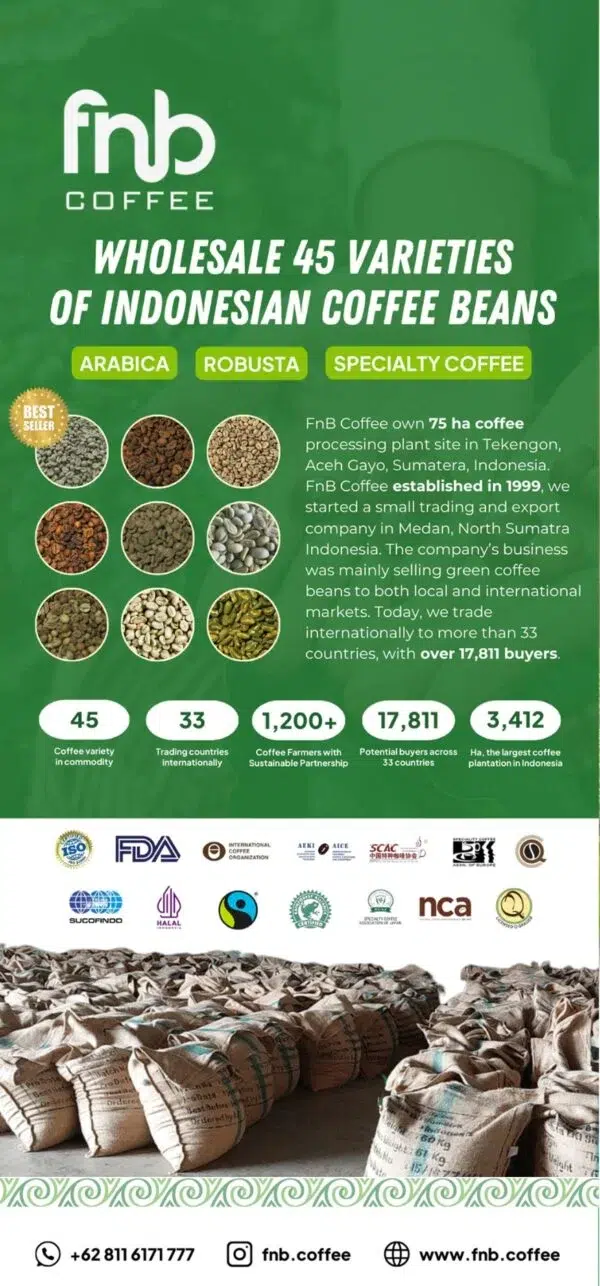
FNB Coffee: Premium Indonesian Beans Worth Grinding Right
Getting the grind right matters even more when the beans are exceptional. That’s exactly why the team at FNB Coffee has spent 26 years sourcing and supplying some of Indonesia’s finest green coffee beans.
Here are a few products worth exploring for different brewing methods:
| Product | Origin | Recommended Brew Method | Grind Level |
|---|---|---|---|
| Gayo Arabica | Aceh, Sumatra | Pour over, AeroPress | Medium fine |
| Mandheling Arabica | North Sumatra | French press, drip | Coarse to medium |
| ELB Green Dino Specialty | Aceh | Espresso, filter | Fine to medium fine |
| Bali Java Gayo & Mandheling Wine | Bali/Sumatra | Drip, cold brew | Medium to extra coarse |
| Kopi Luwak | Sumatra | French press, pour over | Coarse to medium fine |
All products are available in green bean form direct from the source at FNB Coffee, with wholesale and retail options for both individuals and businesses.
Conclusion
Understanding the grind size chart transforms the entire coffee experience. It shifts brewing from guesswork to intention, where every cup becomes a deliberate choice based on the method, the bean, and the flavor the brewer wants to achieve. Once someone learns how grind size connects to extraction, they stop settling for mediocre coffee and start chasing something genuinely excellent.
If getting serious about coffee is the goal, it starts with choosing beans worth grinding. FNB Coffee offers over 50 varieties of premium Indonesian single-origin green beans from bold Sumatra Mandheling to bright Gayo Arabica, all Q-grader certified and ethically sourced. Browse the full catalog at FNB Coffee and order the beans that match the brewing method and the flavor profile that best suits the palate.