Last Updated on 21 Apr 2026 by Tania Putri
If you’re a cafe owner, specialty roaster, or wholesale buyer, you already know that Indonesian green coffee beans carry a reputation unlike almost any other origin in the world. The volcanic soils, the wet-hulling process, and the sheer diversity of regions; Sumatra, Java, Sulawesi, Aceh, Bali produce flavor profiles that simply don’t exist anywhere else on the planet. And yet, so many buyers still find the import process confusing, especially when they’re doing it for the first time.
This guide walks you through exactly how to import coffee from Indonesia the right way. From choosing the right origin and supplier, to understanding logistics, documentation, and pricing. Whether you’re sourcing a trial shipment or planning a full container, this is the practical breakdown you need.
Why Indonesia Is One of the Best Coffee Origins to Source From
Before diving into the how, let’s talk about the why, because understanding what makes Indonesian coffee exceptional helps buyers make smarter purchasing decisions.
Indonesia sits along the equatorial belt sometimes called the “Coffee Belt,” and its archipelago geography creates a remarkable variety of growing conditions. The country is the world’s fourth-largest coffee producer, and its output covers both Arabica and Robusta beans across more than a dozen notable regions.
What sets Indonesian coffee apart is the wet-hulling process (locally known as giling basah). Unlike washed or natural processing used in most other countries, wet-hulling removes the parchment layer from the bean while it still carries high moisture content. The result is a heavier body, lower acidity, and those distinctively earthy, herbal, and sometimes smoky notes that coffee buyers around the world seek out.
For anyone looking to import coffee from Indonesia, this means you’re not just buying a commodity, you’re sourcing a product with genuine character and strong market differentiation.
Understanding the Types of Indonesian Green Coffee Beans Available
When buyers decide to import coffee from Indonesia, one of the first things they discover is the breadth of regional varieties on offer. Here’s a quick overview of the most popular origins:
| Origin | Flavor Profile | Body | Acidity | Best For |
|---|---|---|---|---|
| Sumatra Mandheling | Herbal, dark chocolate, spice | Full | Low | Espresso blends, dark roasts |
| Aceh Gayo | Earthy, buttery, nutty, spicy | Full | Low–Medium | Specialty single-origin |
| Sulawesi Toraja | Fruity, floral, dark fruit, cocoa | Full | Low | Pour-over, filter |
| Kintamani Bali | Citrus, fresh, clean | Medium | Medium–High | Light roasts, pour-over |
| Java | Chocolatey, earthy, mild | Medium–Full | Low–Medium | Blending, espresso |
| Kopi Luwak | Complex, smooth, clean finish | Medium | Low | Premium retail, gifting |
| Liberica | Fruity, woody, jackfruit aroma | Full | Low | Specialty/novelty market |
Each of these beans appeals to a different type of buyer and end customer. A roaster targeting specialty café accounts will gravitate toward Gayo Grade 1 or Toraja, while a brand building a commercial espresso blend might lean heavily on Mandheling or Robusta. Understanding your end-market before you import coffee from Indonesia saves both time and money.
How to Import Coffee from Indonesia: Step-by-Step
Step 1: Choose Your Supplier Carefully
This is the most important decision in the entire process. A trustworthy supplier doesn’t just ship bean, they provide accurate documentation, consistent grading, reliable packaging, and communication you can depend on. Buyers who import coffee from Indonesia for the first time often underestimate how much the supplier relationship affects the quality of the final product.
Look for suppliers that offer:
- Direct sourcing from their own farms or a verified farmer network
- Q Grader-certified cupping and grading (SCA scoring of 82+ for specialty grade)
- Export documentation including Phytosanitary Certificate, Certificate of Origin, and Packing List
- Multiple packaging options (GrainPro liner, jute bags, vacuum-sealed)
- FOB and CIF shipping options
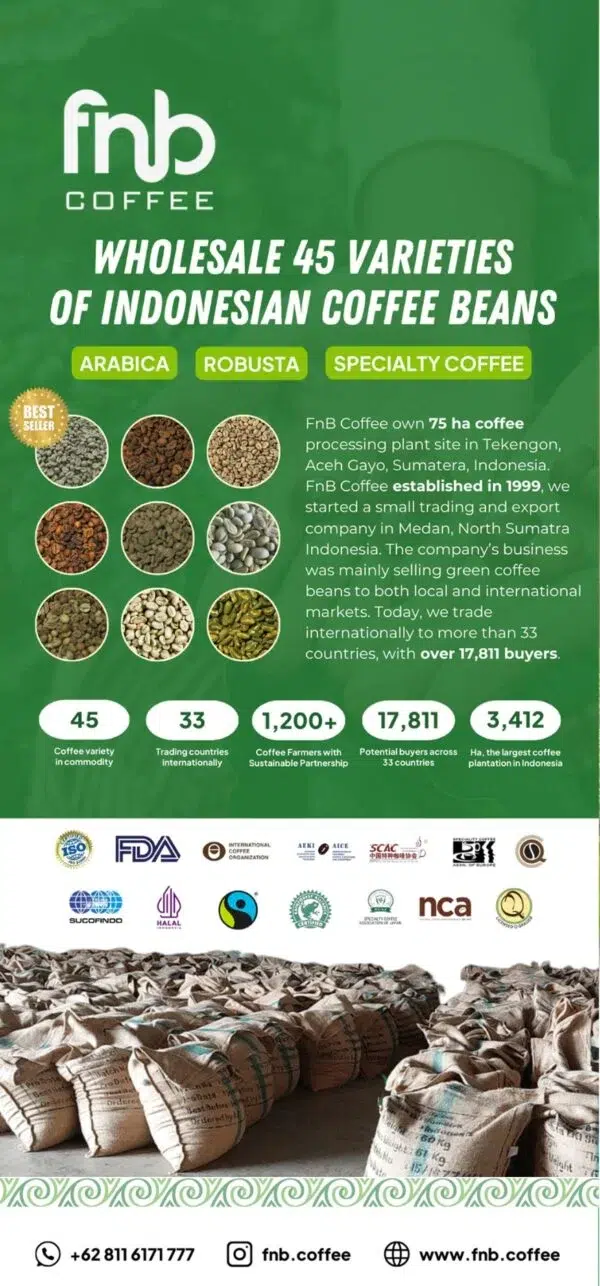
One supplier that consistently meets all of these benchmarks is FNB Coffee, a Sumatra-based exporter with over 26 years of experience and a network of 1,200+ farmers across North Sumatra and Aceh.
Step 2: Request Samples Before Committing to Volume
Never skip the sampling phase. Even when buying from a reputable supplier, your palate and your customer’s palate need to confirm the profile before committing to 1 metric ton or more.
Most professional-grade suppliers, including FNB Coffee, offer samples at their standard retail price (minimum USD $100 per order for retail/sample quantities). Phytosanitary and quarantine certification for green beans costs approximately USD $28 per order, a small investment before a large purchase.
During cupping, evaluate:
- Fragrance (dry), aroma (wet), flavor, aftertaste, acidity, body, and balance
- Moisture consistency (max 13% for properly stored green beans)
- Defect count against the SCA green grading scale
- Screen size uniformity (screen 15–19 for premium Arabica)
Step 3: Understand Import Regulations in Your Country
Every country has different rules for importing agricultural products. Before you import coffee from Indonesia, make sure you understand the regulations in your destination market.
Common requirements include:
- Phytosanitary Certificate: issued by Indonesia’s Ministry of Agriculture, confirming the beans are free of pests and disease
- Certificate of Origin: proves the beans were grown and processed in Indonesia (required for tariff preferences in some markets)
- Import License: some countries require the buyer to hold a valid import permit for agricultural goods
- Food Safety Certification: the EU, US, Japan, and Australia each have their own standards (USDA Organic, EU Organic, Halal, etc.)
FNB Coffee handles the full export documentation process, including phyto certificates, certificates of origin, and packing lists. For buyers in regulated markets, they also supply beans carrying Fair Trade, Organic, USDA, Rainforest Alliance, and Halal certifications, which dramatically simplifies import clearance.
Step 4: Negotiate Pricing and Shipping Terms
When buyers import coffee from Indonesia at wholesale volume, pricing typically works on two models:
- Outright Price: a fixed price per kilogram listed on the supplier’s website for that day
- Differential Basis: a price linked to the C Market (commodity futures), plus the supplier’s differential points. This model works better for long-term contracts and large volume buyers.
Standard wholesale terms from FNB Coffee:
- Minimum Order Quantity (MOQ): 1 Metric Ton per order
- Packaging: 60 kg jute bags, GrainPro, or custom per client requirement
- Shipping terms: FOB (Free on Board) or CIF (Cost, Insurance, and Freight)
- Shipment timeline: typically 2 weeks after contract signing
- Commission structure: USD $25 per ton for referral partners
For first-time buyers below the 1 MT threshold, FnB Coffee also accepts retail orders starting at USD $100, giving buyers the ability to test quality before scaling up.
Step 5: Handle Customs Clearance and Inland Logistics
Once your shipment arrives at the destination port, you’ll need a licensed customs broker to handle clearance. This is especially important when importing agricultural products, as inspections can cause delays without proper documentation.
Key tips for smooth clearance:
- Make sure your phytosanitary certificate is valid and issued within 14 days of shipment
- Keep all commercial invoices, packing lists, and certificates of origin in one file
- Work with a broker who has experience in food-grade agricultural imports
- For the US market, register with the FDA’s Prior Notice system before your beans arrive
FNB Coffee’s Product Line: What You Can Order
If you’re ready to import coffee from Indonesia through FNB Coffee, here’s a snapshot of what their catalog covers. They offer green coffee beans, roasted beans, and ground coffee across more than 40 varieties:
| Product | Type | Grade | Certifications | Cupping Score |
|---|---|---|---|---|
| Sumatra Mandheling | Arabica | Grade 1–6 | Fair Trade, Organic, USDA, Halal | 84+ |
| Aceh Gayo Grade 1 | Arabica | Grade 1 | Rainforest Alliance, Organic | 84+ |
| Sulawesi Toraja | Arabica | Specialty | — | 82+ |
| Kintamani Bali | Arabica | Specialty | — | 82+ |
| Kopi Luwak (Civet) | Arabica | Premium | Fair Trade, Organic, Halal | 85+ |
| Liberica | Liberica | Standard–Premium | — | — |
| ELB Green Dino | Arabica | Specialty | — | 84+ |
| Sumatra Super Peaberry | Arabica | Specialty | — | 84+ |
| Robusta Sumatra | Robusta | Commercial | — | — |
All beans carry an SCA cupping score of 82+ for specialty grades, verified by a certified Q Grader at FNB Coffee’s own cupping lab. This matters especially for buyers who import coffee from Indonesia for specialty café accounts or premium retail, where cup quality is non-negotiable.
Contact FNB Coffee directly: https://fnb.coffee/
Why Buyers Choose FNB Coffee to Import Coffee from Indonesia
There are dozens of Indonesian exporters online, so what makes FnB Coffee the go-to choice for serious buyers?
- 26 years of export experience, with clients across 33+ countries worldwide
- Owned plantations in Pakpak Bharat (North Sumatra) and Takengon (Aceh), not just a broker
- 1,200+ farmer network ensuring consistent supply and traceability
- Rainforest Alliance certified and committed to sustainable, ethical sourcing
- Full export documentation handled in-house, no third-party delays
- Private label / OEM service available for buyers who want to white-label Indonesian coffee under their own brand
- Stock held in Medan warehouse, ready to ship within 2 weeks of contract
For buyers who want to import coffee from Indonesia without the headaches of dealing with brokers, questionable quality, or opaque supply chains, FNB Coffee operates at a level of transparency that’s genuinely rare in the commodity market.
Common Mistakes to Avoid When You Import Coffee from Indonesia
Even experienced buyers make avoidable errors. Here are the top ones to watch for:
- Skipping the sample stage: Always cup before you commit to volume. No exceptions.
- Ignoring moisture content: Green beans should arrive at max 13% moisture. Anything higher risks mold during transit.
- Using the wrong packaging: GrainPro liners inside jute bags are the gold standard. Avoid suppliers who don’t offer this.
- Underestimating documentation: Missing or expired phyto certificates can get your shipment held at customs for weeks.
- Choosing price over quality: The cheapest Indonesian green beans are usually full of defects. If your customers taste the difference, they’ll switch suppliers.
- Not locking in pricing for recurring orders: If you’re planning to import coffee from Indonesia regularly, ask about differential basis contracts to protect against price volatility.
Conclusion
Sourcing green coffee from the Indonesian archipelago offers roasters and buyers access to some of the most distinct, terroir-driven cup profiles available anywhere in the world. Between the wet-hulled Sumatrans, the fruity Torajas, and the clean brightness of Kintamani Bali, the range is genuinely impressive. What matters most is finding a supplier who knows their beans as well as you know your customers.
For buyers ready to take the next step and import coffee from Indonesia with confidence, FNB Coffee is the direct-to-source supplier your business needs. With over 26 years of experience, owned plantations, 40+ bean varieties, and full export documentation support, they make the process straightforward from first order to full container. Visit FNB Coffee today, explore their catalog, and request a sample to start your sourcing journey!
For wholesale inquiries, contact FNB Coffee at [email protected] or call +62 811 6171 777. Minimum sample order: USD $100. Wholesale MOQ: 1 Metric Ton.