Last Updated on 06 Aug 2026 by Pippo Ardilles
When a buyer asks why one bag of Indonesian Arabica costs three times more than another from the same region, the answer almost always comes down to three numbers on a certificate: the cupping score. That number is not a marketing judgment. It is the result of the SCA Specialty Coffee Grading process, an internationally recognized evaluation system developed by the Specialty Coffee Association (SCA).
This guide walks you through exactly how the process of SCA Specialty Coffee Grading works, from the moment you pour a 350-gram sample of green beans onto the inspection table. Through the cupping protocol, to how Indonesian coffee from Sumatra, Aceh, Java, and Bali earns its specialty grade. Whether you are a wholesale buyer comparing lots, a roaster sourcing green beans, or a café owner writing your menu, understanding SCA grading helps you make faster, more confident decisions.
| Key takeaway Specialty coffee = a cup score of 80 or above and zero primary defects in a 350g green bean sample. Both conditions must be met. A coffee that tastes exceptional but contains a single full black bean does not qualify. |
What Is the SCA and Why Does Its Grading Standard Matter?
The Specialty Coffee Association is a non-profit trade organization that sets international standards for coffee quality across the entire supply chain, from farm to cup. Importers, roasters, and green coffee buyers worldwide recognize its SCA Specialty Coffee Grading protocol, originally published in 2004 and significantly updated in 2024 with the Coffee Value Assessment (CVA).
When a supplier claims a coffee is “specialty grade,” it means a certified Q Grader evaluated the lot against SCA criteria. They are a professional who has passed rigorous sensory calibration exams administered by the Coffee Quality Institute (CQI), now under the SCA umbrella. In April 2025, the SCA acquired the licensing rights for the Q Grader certification program, consolidating the industry’s two main quality frameworks under one roof.
For Indonesian green coffee specifically, SCA Specialty Coffee Grading matters because it provides an internationally comparable quality signal. Indonesian coffees are traded globally, and buyers in Europe, Japan, the United States, and Australia make sourcing decisions based on cup scores and defect data. A documented 85-point Gayo Arabica can command a price premium of 30–60% over an ungraded lot from the same region.
The Two-Stage Evaluation: Physical Grading Before Cupping
The SCA Specialty Coffee Grading process begins before any coffee is brewed. A green bean physical inspection determines whether a lot is eligible to enter the cupping stage at all. This is not a formality, it is the gate that separates specialty coffee from commodity coffee.
SCA Specialty Coffee Grading: Green Bean Physical Inspection
A certified Q Grader draws a 350-gram representative sample from a lot and inspects it visually for defects. Each defect carries a numerical value, and the total defect count determines whether the lot passes or fails the physical stage.
| Defect Type | Beans to Count as 1 Defect | Why It Matters |
| Primary Defects: Any single primary defect disqualifies the lot | ||
| Full Black Bean | 4 | Over-fermented / rotted during drying |
| Full Sour Bean | 3 | Excessive fermentation inside the cherry |
| Dried Cherry / Pod | 1 | Undehulled cherry remains in the lot |
| Fungus-Damaged Bean | 1 | Visible mold or mycotoxin risk |
| Foreign Matter | 5 | Stones, sticks, non-coffee material |
| Severe Insect Damage | 1 | Deep pest bore holes through the bean |
| Secondary Defects: Maximum 5 allowed in a 350g sample | ||
| Partial Black Bean | 3 | Partial rot or over-drying |
| Partial Sour Bean | 3 | Localized fermentation |
| Parchment / Pergamino | 2–3 | Incomplete hulling |
| Floater Bean | 5 | Low density, hollow core |
| Immature / Unripe Bean | 5 | Harvested too early |
| Withered Bean | 5 | Water stress during development |
| Broken / Chipped Bean | 5 | Mechanical damage during processing |
| Shell | 5 | Elephant bean split during processing |
| Light Insect Damage | 10 | Shallow surface holes from insects |
For a coffee to qualify as specialty grade:
- The protocol permits zero primary defects in the 350g sample.
- The protocol allows no more than five secondary defects.
- No quakers (underdeveloped beans that fail to roast properly) may appear in a 100g roasted sample.
This is where many Indonesian lots, particularly lower-grade Robusta or improperly processed wet-hulled coffees, fall short of the specialty threshold. A single full black bean or a single full sour bean is enough to disqualify an entire lot, regardless of how the cup tastes.
Moisture and Screen Size
The protocol requires water activity below 0.70 (approximately 12.5% moisture content). Beans that are too wet increase mold risk, while beans that are too dry become brittle during roasting and lose flavor complexity.
The SCA Specialty Coffee Grading protocol records screen size (bean diameter measured through standardized sieves), but it does not determine specialty grade. A large-screened bean can be commercial-grade if it fails cupping, while a small-screened bean from a high-altitude micro-lot can score 90+. Screen size affects roast consistency, not quality classification.
The SCA Specialty Coffee Grading Score: Understanding the 100-Point Scale
SCA Specialty Coffee Grading uses cupping as a controlled tasting protocol. Evaluators roast samples to a standardized light profile that reveals the inherent qualities of the green bean, not the roaster’s skill. Q Graders assess the coffee blind without knowing the origin or producer, and assign scores across multiple attributes.
The Traditional 10-Attribute Score (SCA 2004 Protocol)
Under the legacy scoring system, still widely used in the industry, evaluators assess ten attributes and score each on a scale of 6 to 10:
- Fragrance / Aroma
- Flavor
- Aftertaste
- Acidity
- Body
- Balance
- Uniformity
- Clean Cup
- Sweetness
- Overall (the grader’s holistic impression)
Evaluators subtract defects found in the cup, taints (subtle, 2-point deductions per cup) and faults (clear defects, 4-point deductions per cup) from the total. They calculate the final score as the sum across five evaluated cups.
The SCA Score Tiers
| Score Range | Grade | Category | Market Position |
| 90–100 | Outstanding | Specialty | Super-premium / auction lots |
| 85–89.99 | Excellent | Specialty | Single-origin specialty roasters |
| 80–84.99 | Very Good | Specialty | Specialty market, blenders |
| 70–79.99 | — | Premium / Commercial | High-end commercial blends |
| 60–69.99 | — | Exchange Grade | Commodity market |
| Below 60 | — | Below Standard / Off Grade | Industrial / discard |
| Important nuance The jump from 80 to 90 points is not linear, it is exponential. Most specialty lots score in the 82–88 range. A coffee that reaches 90+ must show flawless consistency across all five cups, with no variance in flavor, zero taints, and a compelling, well-defined origin character. In Indonesian coffee, true 90+ lots are rare micro-lot selections, typically from high-altitude Gayo or Yardang processing stations. |
The 2024 Update: SCA Coffee Value Assessment (CVA)
In November 2024, the SCA Specialty Coffee Grading system officially adopted a significantly updated evaluation framework called the Coffee Value Assessment (CVA). This replaces the 2004 cupping form as the official SCA standard and introduces a more holistic, multidimensional approach to coffee evaluation.
The CVA does not abandon the 80-point threshold for specialty grade, it builds on it. The system consists of four interlocking assessment layers:
| Assessment Layer | What It Evaluates | Key Output |
| Physical Assessment | 350g green bean sample: moisture, screen size, defect count | Lot qualifies or is disqualified before cupping begins |
| Descriptive Assessment | Trained cuppers describe sensory attributes: aroma, flavor notes, acidity, body, texture, aftertaste | Flavor vocabulary — shared language between producer, buyer, roaster |
| Affective Assessment | 9-point hedonic scale: how much do cuppers like each attribute? | Preference score — helps roasters match coffee to target market |
| Extrinsic Assessment | Origin, processing method, certifications, sustainability, traceability documentation | Holistic value beyond cup score alone |
4.1 What Changes for Buyers and Roasters?
The most significant practical shift is the Affective Assessment. Where the old system produced a single number, the CVA distinguishes between two questions: “What does this coffee taste like?” (descriptive) and “How much do you or your target customer like it?” (affective). This matters because a coffee that scores 83 descriptively but receives very high affective scores in a Japanese retail context may command a higher price than an 86-point coffee that doesn’t match consumer preferences in that market.
The Extrinsic Assessment is also new. It formalizes the growing recognition that a coffee’s value includes traceability, certifications, and sustainability credentials, not just what is in the cup. For FNB Coffee’s wholesale buyers, this means lot documentation, farm-level traceability, and certifications (Organic, Fair Trade, Rainforest Alliance) are now formally part of the quality conversation.
The Q Grader program was revised in 2025 to align fully with the CVA framework.
How Indonesian Coffee Is Graded: SNI vs SCA
Indonesia operates two parallel grading systems. Understanding both is essential for buyers sourcing Indonesian green beans.
5.1 SNI (Standar Nasional Indonesia) The Domestic Export Standard
Indonesia’s national grading standard (SNI 01-2907-2008) uses a 300g sample and evaluates defects on a 6-tier scale. This is the system for all Indonesian coffee exports.
| Grade | Max Defects (300g sample) | Typical Origin |
| Grade 1 | 11 | Gayo Aceh, Mandheling Sumatra (top lots) |
| Grade 2 | 25 | Sumatra, Java Arabica |
| Grade 3 | 44 | Various Arabica origins |
| Grade 4a | 60 | Arabica blending grade |
| Grade 4b | 80 | Robusta commercial |
| Grade 5 | 150 | Robusta FAQ |
| Grade 6 | 225 | Robusta bulk / industrial |
Grade 1 is the highest domestic quality tier and the only grade that regularly aligns with SCA specialty requirements. However, SNI Grade 1 is a necessary but not sufficient condition for specialty status, a Grade 1 lot still must pass SCA cupping to earn a specialty designation.
Where SCA and SNI Overlap for Indonesian Specialty
The practical qualification path for Indonesian specialty coffee looks like this:
- Lot passes SNI Grade 1 physical inspection (≤11 defects per 300g).
- Lot is submitted to SCA-protocol cupping by a certified Q Grader.
- Cup score reaches 80+ with zero primary defects in the 350g sample.
- The lab confirms moisture content below 0.70 water activity (≈12.5%).
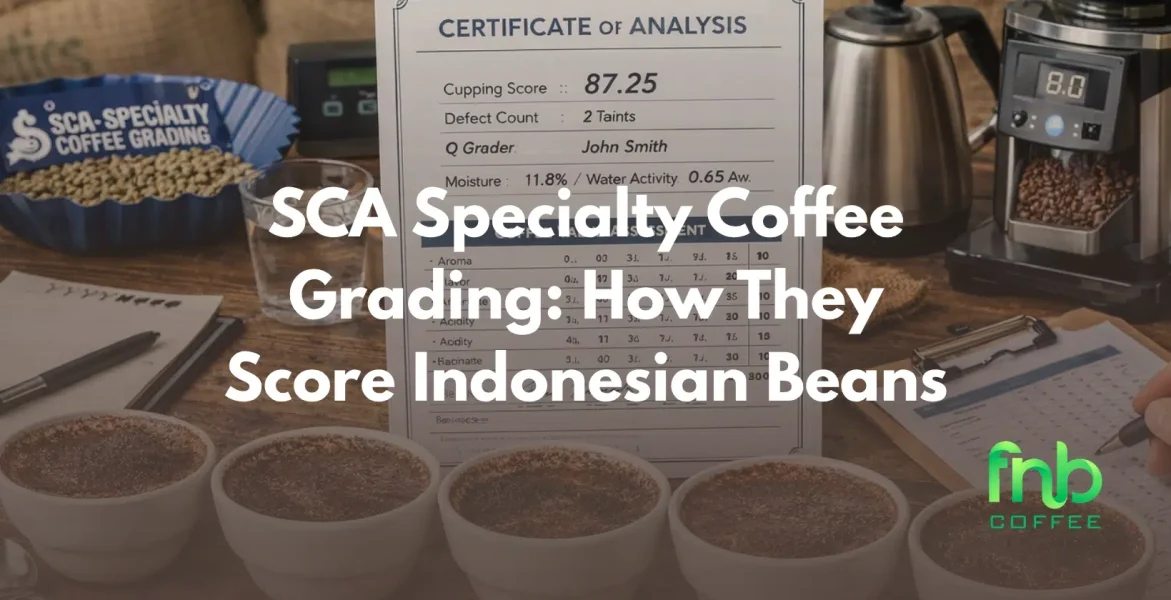
- The lab issues a Certificate of Analysis (COA) that includes the cupping score, defect count, and Q Grader credentials.
6. What Specialty Scores Look Like Across Indonesian Origins
Not all Indonesian coffees approach cupping evaluation the same way. The SCA system was originally calibrated for washed Arabica coffees with clean, bright flavor profiles. Indonesian coffees, particularly those processed through giling basah (wet-hulling), the unique Indonesian post-harvest method have a naturally heavier body, lower acidity, and earthier flavor profile that can score differently under the legacy 10-attribute form than under the newer CVA descriptive framework.
- Gayo Aceh Arabica (washed and natural lots)
Typically scores 84–88 under SCA evaluation. Flavor notes: bright stone fruit, honey, jasmine, clean finish. Washed lots often score higher on acidity attributes than wet-hulled equivalents from the same trees.
- Mandheling Sumatra Arabica (wet-hulled / giling basah)
Typically scores 82–87. Lower acidity is expected and appropriate for origin, a low acidity score does not penalize a Mandheling coffee the way it might penalize an Ethiopian washed lot. Flavor notes: dark chocolate, cedar, earthy, full body.
- Java Arabica (Ijen, Kayumas)
Typically scores 83–87. More balanced than Sumatra, with cleaner acidity and lighter body. Flavor notes: milk chocolate, nuts, subtle fruit.
Typically scores 80–85. Fruity, clean, bright. Lower production volumes make consistent specialty lots harder to source.
- Toraja Sulawesi Arabica
Typically scores 82–87. Rich, spicy, full body. Less common in specialty channels but producing more documented Q Grader-evaluated lots in recent years.
| For wholesale buyers Always request a COA (Certificate of Analysis) that includes: the cupping score, the name and credentials of the Q Grader, the defect count from the physical inspection, moisture/water activity, and the date of evaluation. Scores older than 12 months may not reflect the current condition of the stored lot. |
Common Questions from Wholesale Buyers
Does ‘specialty’ mean organic or fair trade?
No. These are entirely separate designations. Organic and Fair Trade certifications cover farming practices and trade terms. Specialty grade refers exclusively to cup quality as evaluated under the SCA protocol. A coffee can be fully certified organic and still score 76, not specialty. Conversely, an uncertified micro-lot from a small Sumatran farmer can score 88.
Can Robusta coffee be specialty grade?
The SCA’s 10-attribute cupping form was designed for Arabica. However, the CVA system introduced in 2024 is intentionally species-neutral. The SCA is developing Robusta-specific descriptors as part of a 2025–2027 framework expansion. Fine Robusta, particularly washed Robusta from regions like Sumatra and Java, is increasingly evaluated under adapted protocols, with low-defect, clean-cup lots attracting premium pricing from espresso blenders in Europe and Asia.
What is a Q Grader and do I need one to buy specialty coffee?
A Q Grader is a professional certified by the Coffee Quality Institute (now under SCA) who has passed a series of sensory calibration tests and can officially score coffees on the SCA cupping form. You do not need a Q Grader on your team to buy specialty coffee, but the supplier you buy from should provide documentation showing a Q Grader scored the specific lot you are purchasing. At FnB Coffee, all specialty-grade lots are cupped and scored by our in-house Q Grader team before export.
How do I interpret a cupping score on a COA from an Indonesian supplier?
Look for: the score (80+ for specialty), the Q Grader’s license number, the sample weight and preparation protocol used (standard is 8.25g per 150ml water, cupped at five cups), the date, and whether the physical inspection was done on the same sample. A score without a physical defect count is incomplete, a supplier who provides only the cup score and omits defect data may be presenting only favorable data from the evaluation.
Conclusion: The Trusted SCA Specialty Coffee Grading
SCA specialty coffee grading is the coffee industry’s shared language for quality. It exists because “good coffee” is subjective, but a 350g green bean sample and a calibrated Q Grader are not. For anyone buying Indonesian green coffee at scale, whether for a roastery, a café chain, or an import operation, understanding what goes into a cupping score helps you ask the right questions and evaluate competing offers on equal terms.
Looking for coffee you can truly trust? FNB Coffee connects you directly to over 1,200 farmers across Indonesia’s most renowned regions. With every lot carefully evaluated by certified Q Graders and fully documented, you get transparency in every bean. Let’s start your sourcing journey, send us an inquiry today!