
Last Updated on 27 Oct 2026 by Tania Putri
Indonesia grows coffee on more islands than most producing countries have regions, and that is both its appeal and its challenge for buyers. The coffee is excellent and varied, but it reaches the world through a long chain of farmers, collectors, mills, and exporters. Choosing the right Indonesian coffee supplier is what decides whether you get that variety with consistent quality, or a different coffee every shipment.
This guide explains the main types of wholesale coffee dealers in Indonesia, how they compare, what to check before you sign, and how FnB Coffee works as a supplier from origin in North Sumatra.
Why Source Coffee From Indonesia
Indonesia is one of the world’s four largest coffee producers, and its geography gives it an unusually wide range of cups from a single country:
- Sumatra – full-bodied, earthy, low-acid Arabica from Aceh Gayo, Mandheling, and Lintong, plus large Robusta volumes from the south of the island.
- Java – smooth, balanced, chocolate-leaning Arabica from the Ijen and Preanger highlands.
- Sulawesi – complex, spicy Toraja and Kalosi Arabica.
- Bali and Flores – brighter, sweeter cups from Kintamani and Bajawa.
- Papua – small volumes of highland Arabica for niche and specialty buyers.
Most of the national crop is Robusta, which makes Indonesia a dependable origin for espresso blends and instant coffee. The Arabica share is smaller but carries the origins specialty roasters know by name, much of it processed with the local wet-hulled (giling basah) method that gives Sumatran coffee its heavy body. Add natural, honey, and wine-process lots and rare products such as Kopi Luwak, and one supplier can cover a whole menu. To compare the beans side by side, our Indonesian green coffee beans catalog groups them by type and region.
Types of Wholesale Coffee Dealers in Indonesia
“Wholesale coffee dealer” covers very different businesses in Indonesia. Knowing which kind you are talking to tells you what to expect on price, volume, and traceability.
International trading houses
Global commodity traders run Indonesian offices in Lampung, Medan, and Jakarta and move very large volumes, mostly Robusta and commercial-grade Arabica. They suit buyers who need container after container at a market-linked price. The trade-off is that small or specialty lots are rarely their focus, and traceability often stops at the region rather than the farm.
Regional exporters and mills
Many exporters specialize in one origin, for example Robusta from Lampung or Arabica from Toraja or Gayo. They know their area deeply and can be strong on that single coffee. If you need several origins, though, you end up managing several suppliers, each with its own grading habits and paperwork.
Cooperatives and farmer groups
Cooperatives give the most direct line to producers and often hold organic or Fair Trade certification. Buying from them can be rewarding, but most have limited export experience, so documentation, consolidation, and shipping usually need an exporter or importer to handle them.
Origin-based exporter-producers
A smaller group of companies grows, processes, grades, and exports coffee themselves across several regions. This is where FnB Coffee sits. The advantage is one point of contact, one grading standard, and the full Indonesian range from a single account, with samples and export documents handled by the same team.
How the dealer types compare
| Dealer type | Typical volume | Main strength | Watch out for | Best for |
|---|---|---|---|---|
| International trading house | Many full containers | Scale and market-linked pricing | Little focus on small or specialty lots; regional-level traceability | Large blend and instant coffee buyers |
| Regional exporter or mill | LCL to full containers | Deep knowledge of one origin | Several suppliers needed for several origins | Buyers focused on a single origin |
| Cooperative or farmer group | Small to medium lots | Direct producer link, certifications | Limited export, document, and logistics capacity | Certified and direct-trade programs with an import partner |
| Origin-based exporter-producer | Samples to full containers | Full range, one grading standard, export handled | Check certificates and grading records like any supplier | Roasters and importers sourcing several Indonesian origins |
What to Check Before Choosing an Indonesian Coffee Supplier
Whichever type of dealer you work with, these are the points that separate a reliable supplier from a risky one:
- Quality assurance. Ask how lots are graded and what the specs are: screen size, moisture, defect count, and cup score. Indonesian exporters grade green coffee under the Indonesian National Standard (SNI) grading system, so ask which grade you are being offered.
- Variety. A good supplier offers Arabica, Robusta, and specialty lots across several regions and processing styles, so you can grow your menu without adding suppliers.
- Certifications. If you sell organic, Rainforest Alliance, Fair Trade, or Halal coffee, ask for the actual certificates and check that they cover the lot you are buying, not just the company.
- Pricing transparency. Prices move with the New York (Arabica) and London (Robusta) terminal markets, grade, and volume. A supplier should be able to show a current wholesale price list and explain what is included.
- Customization and flexibility. Check whether the supplier can offer different grades, processing methods, packaging, or private label production if your business needs them.
- Reliability and consistency. Ask how they keep a coffee tasting the same from one shipment to the next, and how they schedule deliveries around the harvest.
- Customer support. Responsive communication, clear payment terms, and help with documents matter as much as the coffee when something goes wrong mid-shipment.
Tips for Working With Wholesale Coffee Dealers
- Request samples first. Always cup a pre-shipment sample before you commit to a large order, and keep it as your reference for the delivery.
- Build the relationship. Regular buyers get better allocation of top lots and earlier news about harvest problems.
- Follow the market. Keep an eye on coffee prices and crop reports so you can time contracts and negotiate from knowledge.
- Plan around the harvest. Coffee is seasonal, and the best lots go early, so book volumes ahead instead of buying at the last minute.
- Put the terms in writing. Grade, specs, price basis, payment, shipping window, and how claims are handled should all be in the contract.
For a step-by-step buying process, read our guide on how to buy wholesale coffee beans. If you are importing for the first time, our guide to working with an Indonesian coffee exporter covers documents, shipping times, and a buyer’s checklist.
Why FnB Coffee Is a Reliable Indonesian Coffee Supplier
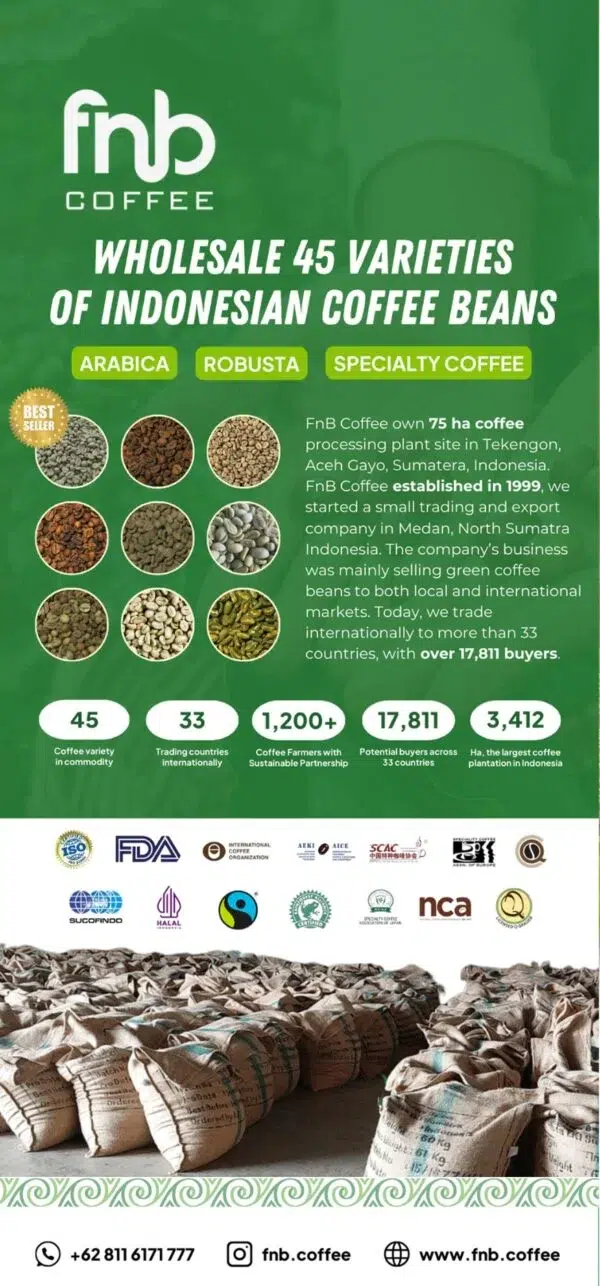
FnB Coffee has supplied Indonesian green coffee since 1999 from origin in North Sumatra. We run offices in Medan and Jakarta, a warehouse near Medan, a 2,621-hectare coffee estate, and a specialty processing site in Central Aceh, in the Gayo highlands, with around 1,200 partner farmers. That lets us buy, process, and grade coffee ourselves instead of reselling whatever a collector has in stock.
- The full Indonesian range. Arabica from Sumatra, Java, Sulawesi, Bali, and Flores, Robusta from Sumatra, Lampung, and Bali, and specialty lots in washed, natural, honey, and wine styles.
- Graded and cupped at origin. Lots are graded to SNI and specialty standards with documented moisture and defect specs, and our cupping service can evaluate a coffee before you buy.
- Samples before you commit. Two 350 g samples let you approve the coffee first, so the delivery matches what you cupped.
- Clear wholesale terms. Wholesale pricing from 9 metric tons per order through our wholesale green coffee program, FOB Belawan or any Indonesian port, with export documents prepared by our own EXIM team.
Frequently Asked Questions
Who supplies coffee wholesale in Indonesia?
Four main groups: international trading houses, regional exporters and mills, cooperatives and farmer groups, and origin-based exporter-producers like FnB Coffee that grow, grade, and export across several regions.
How do I choose an Indonesian coffee supplier?
Compare grading records, the range of origins on offer, certificates for the specific lot, pricing transparency, and how documents and shipping are handled. Always cup a pre-shipment sample before you sign a contract.
Can I buy coffee directly from Indonesian farmers?
You can, but most smallholders and many cooperatives cannot handle export grading, documents, and shipping on their own. Most buyers work through an exporter that has direct relationships with farmers, so the coffee stays traceable without the logistics risk.
What is the minimum order with FnB Coffee?
Wholesale pricing starts at 9 metric tons per order. Smaller quantities are available at retail rates with a USD 100 minimum order, which suits small roasters and trial purchases.
Conclusion
The best wholesale coffee dealers in Indonesia are the ones whose strengths match your program. Trading houses suit very large commodity volumes, regional exporters suit a single origin, and cooperatives suit certified direct-trade projects with an import partner. If you want several Indonesian origins graded to one standard, with samples, documents, and shipping handled by one team, an origin-based exporter-producer is the simplest route.
Ready to source Indonesian coffee? See our wholesale terms, then contact us to request a sample or a quote. You can also reach us on WhatsApp at +62 811 6171 777 or by email at [email protected].

I write for FnB Coffee, and I always have a passion for writing anything that can presents Indonesian Coffee Diversity. From the highlands of Sumatra to the volcanic soils of Java and the unique flavours of Sulawesi, I hope to tell a plethora of stories to showcase the history, customs, and creativity behind Indonesia’s coffee culture. From the cultivation side of farming and sustainability, to brewing and flavor notes, my articles dive into everything to find out what makes Indonesian coffee truly one of a kind.