Last Updated on 02 Apr 2026 by Tania Putri
If you’ve spent any time sourcing coffee for commercial sale, you already know that origin matters a lot. Not just for marketing, but for flavor profiles, harvest cycles, logistics, and ultimately, what your buyers keep coming back for. Understanding coffee growing regions isn’t a nice-to-have; it’s the foundation of a smart sourcing strategy.
This guide breaks down the most important coffee growing regions in the world, what makes each one distinct, and what exporters should consider before selecting their next origin.
Why Coffee Growing Regions Define Everything About the Cup
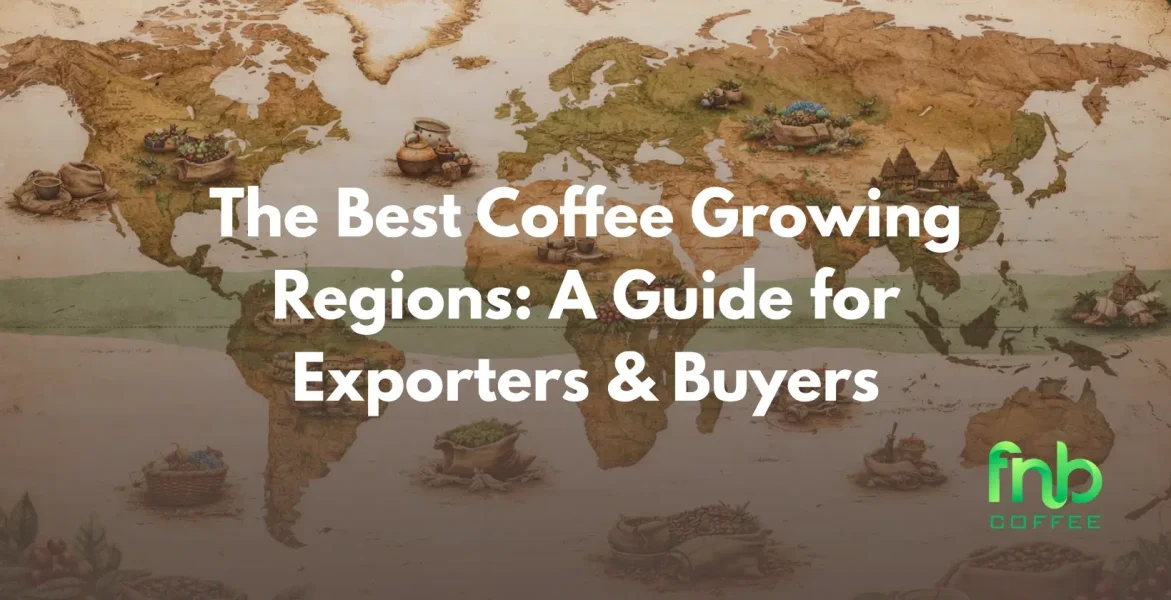
Before diving into the geography, it’s worth understanding why location has such an outsized impact on coffee quality. Coffee thrives in what the industry calls the “Bean Belt” a band stretching roughly between the Tropics of Cancer and Capricorn. Within that belt, however, no two regions produce the same cup.
Altitude, rainfall patterns, soil composition, coffee processing methods explained, and even local farming traditions all shape the final flavor. That’s why a washed Ethiopian Yirgacheffe and a naturally processed Sumatran Mandheling can taste like they come from entirely different plants because, in many ways, they do.
For exporters, knowing the distinctions between coffee growing regions means knowing which origins align with your target market’s taste preferences, price point expectations, and import regulations.
The Major Coffee Growing Regions: A Regional Breakdown
1. Africa — The Birthplace of Coffee
Africa is where it all started. Ethiopia, widely considered the genetic origin of Coffea arabica, continues to produce some of the most complex and sought-after coffees on the market. Kenya, Rwanda, and Burundi have also established themselves as premium origins with strong international demand.
Key countries and their characteristics:
| Country | Altitude (masl) | Flavor Profile | Processing Methods |
|---|---|---|---|
| Ethiopia | 1,500–2,200 | Floral, blueberry, jasmine | Washed, Natural |
| Kenya | 1,400–2,000 | Black currant, tomato, bright acidity | Washed (AA/AB grades) |
| Rwanda | 1,500–2,000 | Caramel, citrus, clean body | Washed |
| Burundi | 1,250–2,000 | Red fruit, sweet, mild | Washed |
African coffee growing regions consistently attract specialty buyers, particularly from Europe, Japan, and the US third-wave market. If your customer base leans toward single-origin espresso or pour-over cafes, African origins should sit near the top of your sourcing list.
2. Latin America — The Reliable Workhorse of the Global Market
Latin America dominates global coffee volume, and for good reason. From Colombia’s misty Andean slopes to Brazil’s vast cerrado plateaus, this region offers incredible diversity in both flavor and price range.
Here’s what exporters need to know about each major origin:
- Colombia: Produces year-round thanks to two harvest seasons (main crop and mitaca). Notes of red fruit, milk chocolate, and caramel make Colombian coffee broadly accessible to consumers. It’s one of the safest commercial bets in the market.
- Brazil: The world’s largest coffee producer by volume. Expect lower acidity, full body, and nutty-chocolatey profiles. Brazil drives the commodity and espresso blend market. Logistics are generally smoother here than almost anywhere else.
- Guatemala: Often underestimated. Guatemalan beans from Huehuetenango or Antigua deliver complex profiles with dark chocolate, spice, and stone fruit notes. Strong demand in specialty channels.
- Honduras: Now Central America’s largest coffee exporter. Price-competitive with improving quality. Good for mid-range commercial blends.
- Peru: Emerging player with growing organic certification. Mild, clean cup with nutty notes. Worth watching as infrastructure improves.
Latin American coffee growing regions remain the backbone of global supply chains. If you need consistency, volume, or competitive FOB pricing, this is where most sourcing conversations begin.
3. Asia-Pacific — Bold, Earthy, and Increasingly Premium
Asia often gets overlooked in specialty circles, but that’s changing fast. The Asia-Pacific region produces some of the most distinctive coffees in the world and, increasingly, some of the most refined.
Top origins to consider:
- Indonesia: Sumatra, Java, Sulawesi, and Flores each offer their own character. Sumatran coffees (especially Mandheling and Gayo) are famous for their heavy body, earthy depth, and low acidity. The wet-hulled (giling basah) processing method is unique to this region and creates that distinctive musty-woody complexity buyers either love or find polarizing.
- Vietnam: The world’s second-largest producer, primarily robusta. Dominant in instant coffee and canned coffee markets across Asia. If your buyer base includes mass-market or RTD brands, Vietnam is hard to ignore on cost-efficiency grounds.
- Papua New Guinea: Underrated origin producing washed arabica with fruit-forward, clean profiles. Gaining traction in Australian and Japanese specialty markets.
- India: Monsoon Malabar is one of coffee’s most recognizable processing curiosities, beans exposed to monsoon winds develop a low-acid, musty, full-bodied character with a devoted following.
Among coffee growing regions, Asia-Pacific offers the widest flavor spectrum, from delicate PNG highlands to aggressively earthy Sumatran naturals. Matching the right origin to the right buyer profile is key here.
How Altitude Shapes Flavor Across All Coffee Growing Regions
Altitude is one of the most reliable predictors of cup quality across all coffee growing regions. Higher elevation means cooler temperatures, which slows the cherry’s maturation process and allows sugars and acids to develop more complexity.
| Altitude Range | Bean Density | Typical Acidity | Flavor Complexity | Common Certification |
|---|---|---|---|---|
| Below 1,000 masl | Low | Low | Mild, simple | Commodity/robusta common |
| 1,000–1,500 masl | Medium | Moderate | Balanced, accessible | Commercial arabica |
| 1,500–1,800 masl | High | Bright | Complex, fruit-forward | Specialty grade |
| Above 1,800 masl | Very High | Very Bright | Exceptional complexity | SCA 85+ scores common |
As a rule of thumb, when evaluating any new origin, ask for the farm’s elevation before you ask for the cupping score. The two often tell the same story but elevation tells it faster.
What Exporters Often Get Wrong About Choosing a Sourcing Region
Most sourcing mistakes don’t happen because of bad coffee. They happen because of a mismatch between origin characteristics and buyer expectations. Here are the most common ones:
- Assuming all African coffees cup the same. They don’t. A Kenya AA and an Ethiopian natural from Guji are worlds apart in flavor and in price behavior.
- Over-indexing on Brazil for specialty blends. Brazil works beautifully as a base, but relying on it exclusively limits differentiation.
- Ignoring logistics when choosing Asian origins. Some Indonesian micro-regions produce exceptional coffee but have inconsistent export infrastructure. Build lead time into your planning.
- Forgetting seasonal variability. All coffee growing regions have distinct harvest windows. Align your purchase orders with harvest cycles, not just your sales calendar.
Seasonal Harvest Calendar by Region
Timing your sourcing correctly means you receive fresher green beans, better cup scores, and more competitive pricing. Here’s a simplified overview:
| Region | Main Harvest | Arrival in Port (Approx.) |
|---|---|---|
| Ethiopia | October – January | January – April |
| Kenya | October – December | December – March |
| Colombia (main) | October – February | December – April |
| Colombia (mitaca) | April – June | June – August |
| Brazil | May – September | August – November |
| Indonesia (Sumatra) | May – October | July – December |
| Guatemala | November – March | January – May |
Planning around this calendar rather than reacting to it separates experienced sourcing teams from the rest.
Certifications That Matter in Coffee Growing Regions
Buyers across the EU, US, and East Asia increasingly ask about certifications before they ask about price. Understanding what’s available from each region helps you pre-qualify your supply chain.
- Organic: Strong availability from Peru, Ethiopia, Honduras, and parts of Indonesia. Requires third-party audit and adds premium pricing power.
- Rainforest Alliance: Common in Colombia, Guatemala, and Central America. Appeals to mass-market and foodservice buyers.
- Fair Trade: Popular in cooperative-heavy origins like Rwanda, Bolivia, and Ethiopia. Strong marketing narrative for retail-facing brands.
- Cup of Excellence (CoE): Country-specific auction lots from Brazil, Colombia, Guatemala, Kenya, and others. If you can secure CoE-winning lots, the premium markup is substantial.
Conclusion
Navigating the world’s coffee growing regions takes more than a map and a cupping session, it takes real market knowledge, timing discipline, and a clear picture of what your buyers actually want. From Africa’s florals to Latin America’s balanced crowd-pleasers to Asia’s earthy depth, every region offers something distinct. The best exporters build a portfolio across multiple origins, not a dependency on one.
Ready to source from the world’s finest coffee growing regions? Visit FNB Coffee today and explore a curated selection of premium green beans from top-producing origins worldwide. Whether you’re building a commercial blend or hunting for your next specialty lot, FNB Coffee connects exporters and roasters directly with the quality and transparency the market demands. Start your sourcing journey now.