Last Updated on 17 Apr 2026 by Tania Putri
When a roaster or importer places a bulk order for Indonesian green beans, one question almost always comes up first: “What grade is this?” And honestly, that’s the right question to ask. Green coffee bean grading is the foundation of every buying decision. It determines consistency, cup quality, and ultimately, how much a buyer can charge in their own market. Yet, many people in the supply chain still mix up the SCA system with Indonesia’s national standard (SNI), or they toss terms like “Grade 1” and “AA” around without really knowing what separates one from the other.
This article breaks it all down clearly. From the actual numbers behind each grade to the products FNB Coffee ships fully graded and export-ready.
Why Green Coffee Bean Grading Matters Before You Buy
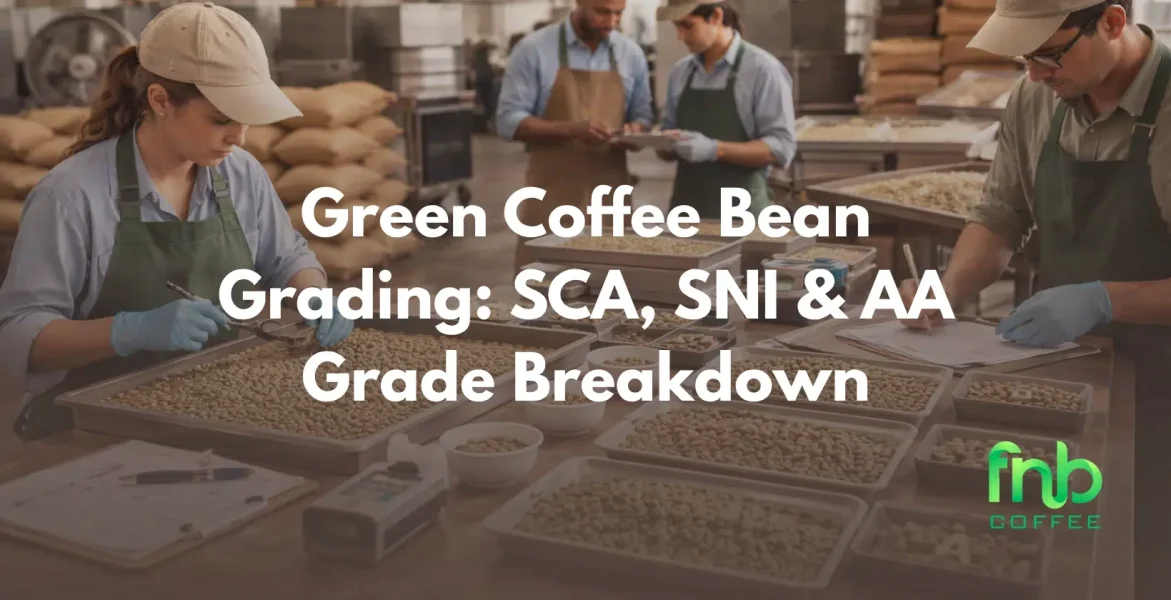
Grading is not just a label. It is a promise about what is inside the bag. A proper green coffee bean grading system evaluates at least four key parameters: moisture content, defect value, screen size (bean size), and cup quality score. Skipping any one of those parameters leads to inconsistency in the roast, unpredictable flavors, and for commercial buyers, customer complaints.
There are two main grading frameworks that buyers encounter when sourcing Indonesian beans: the SNI 01-2907-2008 standard issued by Indonesia’s national body (BSN), and the SCA (Specialty Coffee Association) cupping protocol used internationally. They measure different things, but the best beans, like those from FNB Coffee satisfy both.
SNI 01-2907-2008: Indonesia’s Official Coffee Grading Standard
SNI 01-2907-2008 is the Indonesian national standard for green (unroasted) coffee beans. It applies to both Arabica and Robusta and classifies beans using a defect value system. Each type of defect, full black beans, stones, husks, broken beans, insects is assigned a specific point value. Those points are added up from a 300-gram sample, and the total determines the grade.
SNI Grade Classification Table (Arabica)
| Grade | Max Defect Value (per 300g) | Max Moisture | Typical Screen Size | Notes |
|---|---|---|---|---|
| Grade 1 | Max 11 | Max 12.5% | Screen 15–19 | Specialty / Export premium |
| Grade 2 | Max 25 | Max 12.5% | Screen 15–19 | Commercial export |
| Grade 3 | Max 44 | Max 13% | Screen 14–18 | Standard commercial |
| Grade 4a | Max 60 | Max 14% | Mixed | Local market |
| Grade 4b | Max 80 | Max 14% | Mixed | Local market |
| Grade 5 | Max 150 | Max 14% | Unscreened | Industrial / low grade |
| Grade 6 | Max 225 | Max 14% | Unscreened | Lowest commercial grade |
So when FNB Coffee’s Sumatra Mandheling listing shows “Defect Value: Max 11, Grade 1”, that is a Grade 1 by SNI 01-2907-2008 meaning it is the cleanest category available under Indonesian law, with zero room for major primary defects.
Understanding Defect Value in Practice
Each defect carries its own weight. For example, one full black bean = 1 defect point, one stone = 5 points, one husk = 1 point, and so on. A 300-gram sample that contains five full-black beans and two stones already accumulates 15 defect points, which would push it out of Grade 1 into Grade 2. This is why proper green coffee bean grading requires trained sorters and ideally a certified lab setting, not just a quick visual check.
SCA Grading: The International Specialty Standard
The Specialty Coffee Association uses a different lens. Instead of just counting physical defects, SCA evaluates the cup itself through a trained Q Grader cupping protocol. A coffee must score 80 points or above on the SCA 100-point scale to be considered “specialty.” Anything below 80 is commercial grade, regardless of how clean it looks on paper.
SCA Score Tiers
- 90–100: Outstanding / world-class single origin
- 85–89.99: Excellent specialty — premium export tier
- 80–84.99: Very good specialty — entry-level specialty
- Below 80: Commercial / below specialty threshold
FnB Coffee applies this standard rigorously. Their certified Q Grader team cups every lot, and they only release beans that score 82 or above for wholesale. Their flagship specialty SKUs, ELB Green Dino and Sumatra Mandheling Grade 1, both carry a cupping score of 84+, putting them firmly in the “very good specialty” bracket recognized globally.
What Does “AA Grade” Actually Mean?
Here is where confusion often starts. “AA” is not part of the SNI or SCA framework. It is a screen-size designation commonly used in East African coffee (Kenya AA, Tanzania AA), where “AA” indicates beans that pass through a screen size 18 hole (approximately 7.1mm diameter). In the Indonesian and Sumatran context, buyers sometimes use “AA” loosely to mean large, premium beans, but it has no formal definition under SNI 01-2907-2008.
The correct Indonesian equivalent is a screen size classification. A screen 18+ bean in Sumatra is considered large, while screen 15–17 is standard commercial. When FNB Coffee lists “Screen Size: 15–19” on their Mandheling beans, that range covers both standard and large categories, giving roasters flexibility. Their ELB Green Dino and Jumbo 18+ products specifically target the large-bean segment, hand-selected for size above 18 screen, which is the Indonesian equivalent of what African markets call “AA.”
Screen Size Reference Table
| Screen Number | Diameter (mm) | Classification |
|---|---|---|
| 20+ | 7.9+ | Elephant / Jumbo |
| 18–19 | 7.1–7.5 | AA equivalent / Large |
| 16–17 | 6.3–6.7 | AB / Standard premium |
| 14–15 | 5.6–6.0 | C / Commercial |
| Below 14 | <5.6 | PB (Peaberry) or low grade |
Moisture: The Hidden Quality Factor in Green Coffee Bean Grading
Moisture is arguably the most overlooked parameter in green coffee bean grading, yet it directly controls shelf life and roast behavior. SNI 01-2907-2008 caps moisture at a maximum of 12.5% for Grade 1 Arabica. The SCA recommends 10–12% for optimal storage and roast consistency. Beans above 13% become a liability, they mold faster, roast unevenly, and produce flat, grassy cups.
FNB Coffee controls moisture tightly across their entire catalog. Every product listing shows “Moisture: Max 13%,” and their Grade 1 premium lines, Mandheling and ELB Green Dino, are processed and stored in GrainPro liner bags specifically to hold moisture stable during international shipping.
FNB Coffee Products: Graded, Certified, and Ready to Ship
Understanding green coffee bean grading is most useful when applied to actual buying decisions. Here is a quick look at how FNB Coffee’s key products line up against both grading systems.
| Product | SNI Grade | Defect Value | Screen Size | Cupping Score | Moisture |
|---|---|---|---|---|---|
| Sumatra Mandheling | Grade 1 | Max 11 | 15–19 | 84+ | Max 13% |
| ELB Green Dino | Grade 4–5 (by defect) | 151–225 (as per sample) | 13–19 (hand-selected large) | 84+ | Max 13% |
| Sumatra Super Peaberry | Specialty | As per sample | Peaberry (round) | SCA Specialty | Max 13% |
| Jumbo 18+ | Grade 1–2 | Low | 18+ | 84+ | Max 13% |
| Musty Cup | Grade 3–4 | As per sample | 13–19 | Commercial | Max 13% |
Note on ELB Green Dino: Its high defect value on paper reflects the intentional inclusion of diverse bean sizes in the “as per sample” disclosure. However, it is hand-selected for large bean size and cupped at 84+, making it a specialty-cup product despite an SNI Grade 4–5 classification. This is a good example of why buyers should always evaluate both the SNI number AND the SCA cupping score together, not one in isolation.
How FNB Coffee Ships Fully Graded Beans
One practical concern for importers and roasters is whether a supplier actually exports with full documentation. FNB Coffee handles this end-to-end. Every export shipment from their Medan warehouse comes with:
- Phytosanitary certificate and quarantine clearance
- Certificate of Origin (COO)
- Lab analysis (moisture, screen size, defect count)
- Q Grader cupping report (for specialty SKUs)
- GrainPro or jute bag packaging (60 kg standard lots)
Their minimum export order is 1 metric ton (MT) FOB or CIF, with FOB Belawan / Medan as the standard departure point. For buyers testing for the first time, retail-sized sampling starts from USD 100 with phyto and quarantine at a flat USD 28 per order for green bean samples.
Conclusion
Getting green coffee bean grading right is not optional for serious buyers, it is the difference between a repeatable product and a sourcing gamble. SNI 01-2907-2008 governs defect tolerance and moisture, SCA scores validate cup quality, and screen size tells you bean uniformity. Together, these three pillars define what a grade actually means. When a supplier can show documented numbers across all three, not just a loosely applied “Grade 1” label. That is who deserves a long-term contract.
FnB Coffee has spent over 26 years building exactly that kind of transparency, from their 3,412-hectare plantation network in Aceh and North Sumatra to Q Grader-certified export lots shipped to more than 33 countries. Whether you need a clean Grade 1 Mandheling for a specialty roaster or a bold large-bean ELB Green Dino for a premium blend, the stock is in the warehouse and the documents are ready. Visit FNB Coffee now and talk to their team today, because the best Indonesian green beans go to buyers who move first.