Last Updated on 27 Oct 2026 by Pippo Ardilles
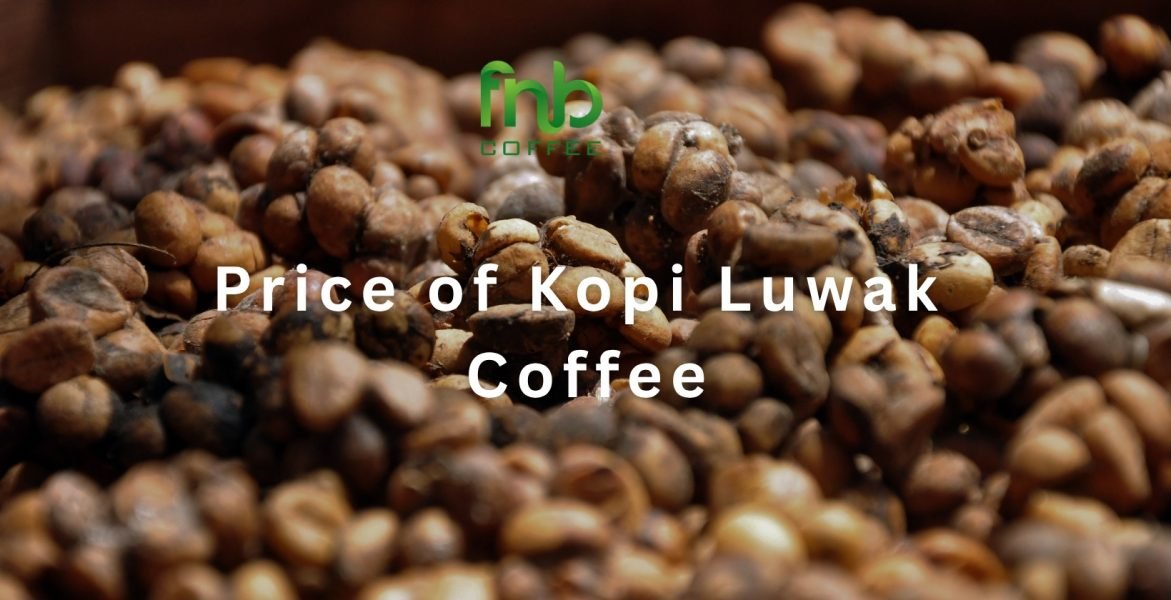
Genuine roasted kopi luwak coffee sells for roughly $100 to $600 per pound at US retail, the highest price of any commercial coffee on the market. But if you are buying green (unroasted) beans at volume, you pay a fraction of that per kilogram, set by lot, grade, and order size rather than a shelf price.
We supply Indonesian green coffee to roasters and importers, and this question lands in our inbox every week: what are you actually paying for? Below is a straight breakdown of 2026 retail, wholesale, and green-bean pricing in USD, plus the factors that push the number up or down.
How Much Does Kopi Luwak Cost in 2026?
The answer depends on where you buy. Retail prices include roasting, small-pack packaging, importing, and brand margin, so they sit many times above origin prices.
| Where you buy | Typical price | Per-kg equivalent |
|---|---|---|
| US retail, roasted (1 lb bag) | $100–$600 per lb | about $220–$1,320/kg |
| Small gift packs (50–100 g) | priced per tin | often above $1,000/kg once converted |
| Origin wholesale, FnB Coffee | USD 50–78 per kg | USD 50–78/kg |
A single café cup ranges from under $10 to around $100, depending on the venue and whether the coffee is genuine. Retail figures are third-party market ranges, not FnB Coffee prices, and they move with harvest, currency, and authenticity.
For country-level retail prices, see our guides for the United States, the UK, India, and Australia.
Kopi Luwak Price per Kg: Green, Roasted, and Ground
Our indicative range is USD 50–78 per kg across all three formats. Green beans sit at the lower end because roasting and grinding add processing cost and shorten shelf life.
| Format | Indicative price (USD/kg) | Best for | Notes |
|---|---|---|---|
| Green beans | Lower end of 50–78 | Importers, roasters, distributors | You control the roast profile; +USD 28 phyto & quarantine per order |
| Roasted beans | Within 50–78 | Cafés, hotels, specialty retailers | Roasted to an agreed profile and packed to order |
| Ground | Within 50–78 | Hospitality, gifting, private label | Ground to your brew method and sealed immediately |
Three terms apply to every order:
- Minimum purchase: USD 100.
- Firm price: issued against a named lot and confirmed volume, with that lot’s cupping report.
- Shipping: quoted separately from the coffee.
Current lots are Arabica from Sumatra, Java, and Bali, semi-washed, screen size 15–18, moisture max 13%, defect value max 11, and a cupping score of 87. Processing is Halal certified. To lock in a price for your volume, send your format and quantity for a wholesale quote.
Why Is Kopi Luwak So Expensive?
Kopi luwak is expensive because animals, not planting decisions, set the supply, and every later step is manual. Six costs stack on top of one another:
- Civets cap the supply. Wild Asian palm civets eat only the cherries they judge ripe, and nobody can speed them up. A garden yields kilograms per season, not tons.
- Collection is done on foot. Farmers walk the gardens at first light to gather what the civets left overnight. Labour per kilogram is far higher than a normal harvest.
- Washing is non-negotiable. Beans are washed repeatedly in clean running water before they reach a drying bed. Poor washing is what gives the category its musty, unsafe reputation.
- Drying and sorting are manual. Beans are sun-dried on raised beds to a maximum of 13% moisture, then defects are picked out by hand. Sorting removes a meaningful share of what was collected.
- Ethical sourcing limits volume. Wild collection produces far less than caged, force-fed operations. That is a deliberate trade-off, and it is the main reason genuine lots stay scarce.
- Every lot is documented. Genuine lots are cupped and documented one at a time, with a Certificate of Origin and Phytosanitary Certificate for export. That costs more than grading a container of commodity coffee.
For the full step-by-step process, read how kopi luwak is produced. Grade also moves the price; our kopi luwak grading guide explains how.
Wild vs Captive: How the Source Changes the Price
The single biggest price variable is how the beans were produced. The market splits into three tiers:
| Source tier | How it is produced | Relative price | Buyer risk |
|---|---|---|---|
| Wild-sourced | Free-roaming civets in coffee gardens; beans collected on foot | Highest | Low, if the lot is documented |
| Ethical captive | Spacious enclosures, varied diet, veterinary care | Mid to high | Medium; welfare claims need checking |
| Industrial caged | Caged, force-fed civets | Lowest | High; often mislabelled as “wild” |
A low-priced “wild” kopi luwak is almost always either caged-civet coffee or ordinary Arabica blended with a small share of civet beans. Our comparison of wild vs caged civet coffee covers the welfare side in detail.
Why Retail Prices Look So Much Higher
Small packs inflate the per-kilogram figure. Before comparing two offers, convert both to price per kg:
| Pack size | Weight | Multiply the price by |
|---|---|---|
| 100 g tin | 0.10 kg | ×10 |
| 8 oz bag | 0.227 kg | ×4.4 |
| 12 oz bag | 0.340 kg | ×2.94 |
| 1 lb bag | 0.454 kg | ×2.2 |
A $45 tin of 100 g is really $450 per kg. At a 12 g dose per cup, coffee at USD 78/kg costs about $0.94 per cup in beans, while retail coffee at $1,320/kg costs about $15.84.
How to Evaluate a Kopi Luwak Price Before You Buy
Compare the total buying cost and the proof behind it, not just the number per kg. Ask every supplier for:
- Price per kg, with the format stated (green, roasted, or ground)
- Minimum purchase and any document fees
- The collection area and harvest period of the specific lot
- A cupping report tied to that lot, with the grader named
- Moisture level, screen size, and defect value
- A pre-shipment sample from the actual lot
- Certificate of Origin and Phytosanitary Certificate
- A described collection method you could inspect
If a seller cannot answer these, a low price is a risk signal, not a bargain. Our guide on how to identify real kopi luwak goes deeper into authenticity checks.
Is Kopi Luwak Worth the Price?
For most buyers, kopi luwak is a premium line rather than an everyday coffee. Its value comes from rarity, a verifiable origin story, and a smooth, low-bitterness cup with chocolate, caramel, and nutty notes.
It is worth the price when the lot is documented and the welfare claim can be checked. It is not worth it when you are paying for a name with nothing behind it. To see how it compares with other luxury lots, read our guide to the world’s most expensive coffees.
How to Get a Wholesale Kopi Luwak Quote
Buying at origin removes several layers of markup. Our ordering process has four steps:
- Quotation (1 business day): send format, volume, and destination; you receive a lot-specific offer with the cupping report.
- Sample (3–7 days): a 350 g pack from the actual lot ships to your cupping table.
- Contract (1–3 days): volume, format, packaging, and Incoterms are fixed in writing.
- Shipment (from 2 weeks): packed to specification and dispatched from Belawan or another Indonesian port.
Sample terms are in our sample policy. When you are ready, request your kopi luwak quote and samples.
FAQ
1. How much does kopi luwak cost?
Genuine roasted kopi luwak sells for about $100–$600 per pound at US retail. At origin, FnB Coffee’s indicative wholesale range is USD 50–78 per kg.
2. How much is kopi luwak per kg wholesale?
Our indicative range is USD 50–78 per kg, depending on format, origin, lot, and volume. A firm price is issued against a named lot, and shipping is quoted separately.
3. Why is kopi luwak so expensive?
Supply is capped by wild civets, collection and sorting are manual, and each lot is cupped and documented separately. Ethical, wild-sourced collection limits volume further.
4. Is green kopi luwak cheaper than roasted?
Yes. Green beans sit at the lower end of the range because roasting and grinding add processing cost. Roasters and importers usually buy green to control the roast profile.
5. What is the minimum order, and are there extra costs?
The minimum purchase is USD 100. Green-bean orders add USD 28 per order for phytosanitary and quarantine handling, and shipping is quoted separately.

I write for FnB Coffee, and I always have a passion for writing anything that can presents Indonesian Coffee Diversity. From the highlands of Sumatra to the volcanic soils of Java and the unique flavours of Sulawesi, I hope to tell a plethora of stories to showcase the history, customs, and creativity behind Indonesia’s coffee culture. From the cultivation side of farming and sustainability, to brewing and flavor notes, my articles dive into everything to find out what makes Indonesian coffee truly one of a kind.