Last Updated on 13 May 2026 by Tania Putri
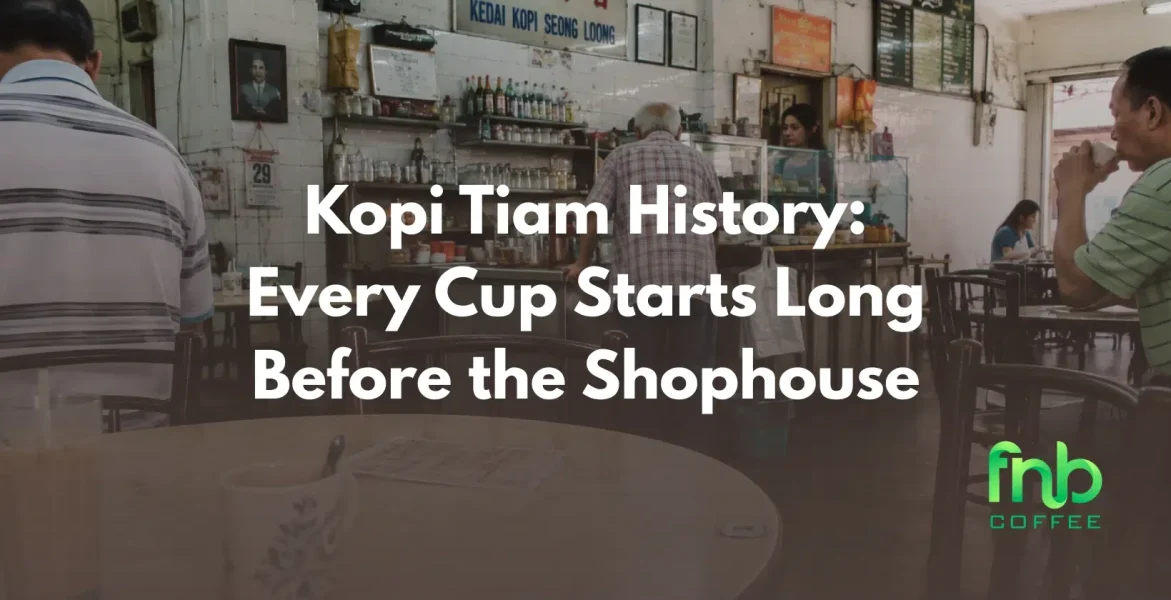
Ask most people what defines a kopi tiam, and they will describe the scene. The marble tabletops. The worn wooden stools. The uncle in a singlet pulling coffee through a cloth sock with practiced, unhurried confidence. That picture is real, and it matters. But there is a deeper story happening before any of that, one that begins on a hillside in Sumatra, moves through trading ports, and quietly shapes every cup that lands on those marble tables.
Understanding kopi tiam history means understanding the full chain, from the farmers who grew the robusta and arabica that built this culture, to the roasters who perfected the butter-and-sugar technique, to the shophouse owners who turned a morning ritual into one of Southeast Asia’s most enduring institutions. That is the version of the story worth telling, especially if you are in the business of sourcing the beans that keep this tradition alive.
The Green Bean Behind the Legend: Where Kopi Tiam History Really Begins
Most food histories focus on the finished product. Kopi tiam history, however, is inseparable from the agricultural story of Indonesia, a country that has supplied the region’s coffee trade for over three centuries. When Dutch colonists introduced coffee cultivation to Java in the late 17th century, they set in motion a supply chain that would eventually feed every kopi tiam from Penang to Pontianak.
The beans that defined early kopi tiam culture were almost entirely robusta. Robusta thrives at lower altitudes, resists disease more readily than arabica, and produces a thicker, more bitter brew with higher caffeine content. For communities that needed an affordable, energizing morning drink, it was a practical and economical choice. Farmers in Sumatra, Java, and Sulawesi grew robusta that found its way into trading ports, then into the hands of Hainanese roasters who had settled across maritime Southeast Asia.
Kopi tiam history from this angle is a story of supply chain ingenuity. The Hainanese, who arrived in significant numbers during the 19th century, quickly recognized that coffee could anchor a small business. They sourced beans from local traders, developed a distinctive roasting style using sugar and butter or margarine, and built their shophouses into community fixtures that worked precisely because the beans were affordable, consistent, and locally available.
The Roast That Built a Culture: How Kopi Tiam History Shaped Green Bean Demand
Why Robusta Dominated Early Kopi Tiams
The kopi tiam history of roasting is one of practical creativity. Early roasters did not have access to modern drum roasters or precision temperature controls. Instead, they worked with woks, wood fires, and a technique that combined high heat with added fats and sugar to slow the roast, develop sweetness, and smooth out the harsh edges that raw robusta could carry.
This method, sometimes called the Hainanese roasting style, created a profile that worked beautifully with sweetened condensed milk. The bitterness and body of robusta stood up to the sweetness of the milk without being overwhelmed. The caramelized notes from the sugar-and-butter roast added depth. The result was a drink designed for balance, not complexity.
What this meant for green bean sourcing was consistent, heavy demand for robusta at a commercial grade. Farmers in Sumatra and Java supplied that demand for generations. As kopi tiam culture expanded from Singapore and Penang into Kuala Lumpur, Jakarta, and beyond, so did the appetite for reliable robusta supply.
The Arabica Shift and What It Means Today
Kopi tiam history in the 21st century is partly a story of evolution. A new generation of kopi tiam operators, many of them working in cities with access to specialty-grade arabica, has begun blending high-quality arabica into traditional kopi tiam recipes. This does not replace the robusta base. Instead, it layers additional flavor complexity on top of it.
Arabica from the Gayo highlands of Aceh, the volcanic slopes of Bali’s Kintamani, and the estates of Java’s Preanger region now appears in progressive kopi tiam menus across the region. Buyers sourcing for these establishments increasingly look for both commodity robusta and specialty arabica in their green bean orders.
For green bean suppliers, this shift represents a real commercial opportunity. A roaster supplying a cluster of kopi tiam operators needs both a reliable robusta base and access to traceable, graded arabica lots for premium offerings.
The Three Regional Variants and the Beans Behind Them
One of the most useful things to understand about kopi tiam history is that regional identity is driven as much by bean origin as by preparation style. Each major kopi tiam culture developed around whatever coffee was most available and affordable in its region. And studying this aspect of kopi tiam history reveals something surprising: the cup you drink is essentially a map of the trade routes and farming communities that surrounded each city.
Indonesian Kedai Kopi: Sumatra at the Center
In Indonesia, the kedai kopi tradition grew up with Sumatra robusta and arabica at its core. Cities like Medan, which sits at the commercial heart of North Sumatra, developed a strong kopi tiam culture tied directly to proximity to origin. Locally grown beans meant local identity, and a cup of kopi in Medan carries the terroir of the surrounding highlands in every sip.
The wet-hulling process, known locally as giling basah, gives Sumatran coffees their characteristic earthy, full-bodied profile. This processing method, unique to Indonesia, produces beans with lower acidity and a heavy, syrupy body that translates powerfully in the traditional kopi tiam cup. For anyone sourcing beans to recreate or honor this tradition, Indonesian origin is not optional; it is the point.
Singaporean Kopitiam: When Imported Beans Became Local Culture
Singapore’s kopi tiam history developed slightly differently. As a trading hub, Singapore imported robusta primarily from Indonesia and Malaysia, roasted it locally using the Hainanese butter-and-sugar method, and built an entire food culture around it. The Singaporean kopitiam is so embedded in national identity that it has been protected as part of the UNESCO-recognized hawker culture.
The key insight for modern green bean buyers is that Singapore’s kopi tiam tradition always depended on reliable Indonesian and Malaysian supply. That dependence continues today.
Malaysian Kopi Tiam: Penang’s Living Heritage
Malaysia, particularly Penang’s George Town, carries what many consider the most living version of traditional kopi tiam culture. Penang’s proximity to Sumatra historically made Indonesian beans accessible, and the city’s Hokkien-Chinese community shaped the preparation style that still defines the experience today. The Penang Heritage Trust actively documents this culture as an irreplaceable part of the city’s identity.
Comparing the Regional Kopi Tiam Traditions: A Buyer’s Reference
| Dimension | Indonesia (Kedai Kopi) | Singapore (Kopitiam) | Malaysia (Kopi Tiam) |
|---|---|---|---|
| Dominant Bean Type | Sumatra Robusta + Arabica | Imported Robusta | Robusta, some Arabica |
| Roast Style | Dark, earthy | Dark, butter-sugar | Medium-dark, butter-sugar |
| Primary Flavor | Earthy, bold, bitter | Caramelized, rich | Nutty, rounded, bright |
| Green Bean Origin | Sumatra, Java, Sulawesi | Indonesia, Malaysia | Indonesia, Malaysia |
| Unique Marker | Giling basah processing | Hainanese roast method | Penang-style thick brew |
| Modern Specialty Trend | Gayo, Kintamani arabica | Single-origin blends | Specialty alongside classic |
What Makes a Kopi Tiam Authentic in 2026?
The question of authenticity matters more now than ever. As third-wave coffee culture spreads through Southeast Asian cities, some operations borrow the kopi tiam aesthetic without the substance behind it. Regulars and serious buyers can usually tell the difference, and so can the supply chain.
A genuinely authentic kopi tiam, whether traditional or modernized, typically shares these defining characteristics:
- Robusta at the base. Even progressive operators who add arabica to their menu keep robusta in the blend. The thick body and bold bitterness of good robusta is structural; it holds the drink together.
- A real roasting process. Traditional operators roast in-house or source from dedicated kopi tiam roasters who still use the sugar-and-butter method. The roast is part of the identity.
- Condensed and evaporated milk. These are not shortcuts; they are essential ingredients with decades of established flavor logic behind them. Fresh dairy changes the profile in ways that purists reject.
- Cloth sock brewing. The kain tapisan produces a textured, oil-forward brew that paper filters do not replicate. Body and mouthfeel are hallmarks of the tradition.
- Community pricing. A kopi tiam serves working people. The pricing reflects that. Operators who source efficiently get to maintain that accessibility.
For roasters and operators who want to source green beans that support all five of these markers, origin quality and processing consistency matter enormously. The Specialty Coffee Association notes that consistent bean quality at origin is the single most controllable variable in achieving cup consistency downstream.
The Supply Chain That Keeps Kopi Tiam History Alive
There is a reason kopi tiam history has endured while countless other food traditions faded. It is not just culture; it is commerce. The tradition survived because there was always a reliable, affordable supply of good Indonesian coffee to support it.
That supply chain runs through places like Pakpak Bharat in North Sumatra, the Gayo highlands of Aceh, the Kintamani plateau in Bali, and the Preanger estates of West Java. These growing regions, many of them operating for over a century, produce the green beans that roasters transform into the kopi tiam experience.
FnB Coffee operates directly from these origins. As a plantation-to-export supplier with over three decades of presence in Sumatra’s coffee highlands, FnB Coffee sits at the beginning of this supply chain, not downstream of it. For roasters who supply kopi tiam operators, that direct origin access translates into pricing, traceability, and quality control that is simply not available through intermediary trading.
Green Bean Products for Kopi Tiam Operators and Roasters
If you source green beans for kopi tiam roasting or want to build a supply relationship with a direct Indonesian origin supplier, here are the FnB Coffee products most relevant to this tradition:
| Product | Bean Type | Processing | Flavor Profile | Best Application | Price Range |
|---|---|---|---|---|---|
| Sumatra Mandheling | Arabica | Wet-hulled | Earthy, dark chocolate, full body | Traditional kopi O base | $13 – $37 |
| Sumatra Robusta | Robusta | Natural | Bold, bitter, low acid | Classic kopi tiam blend | $11 – $23 |
| Aceh Gayo Coffee | Arabica | Washed | Clean, citrus, complex | Premium kopi tiam blends | $19 – $34 |
| Gayo Natural | Arabica | Natural | Fruity, syrupy, heavy body | Specialty kopi tiam menu | $33 – $54 |
| Kopi Luwak | Arabica | Semi-washed | Smooth, nutty, caramel | Premium showcase offering | $50 – $94 |
| Java Coffee | Arabica | Washed | Bright, herbal, clean | Singapore-style blends | $20 – $34 |
| Bali Natural | Arabica | Natural | Sweet, tropical, full | Modern kopi tiam menu | $32 – $53 |
For buyers who want to explore FnB Coffee’s complete Sumatra offering, the Sumatra Coffee Selections page covers the full range, from commercial robusta to specialty-grade arabica lots. Those looking for certified specialty-grade options should visit the Indonesia Specialty Coffee Beans section, which includes Q-Grader evaluated lots suitable for premium kopi tiam menus.
The International Coffee Organization positions Indonesia as the world’s fourth-largest coffee producer, and FnB Coffee’s Rainforest Alliance-certified supply chain represents exactly the kind of sustainable, traceable sourcing that modern kopi tiam operators increasingly demand.
Conclusion
Kopi tiam history is a centuries-long conversation between farmers, traders, roasters, and communities, and every participant in that chain matters. The shophouse uncles who pour coffee at dawn did not build this tradition alone. They built it on top of a reliable supply of quality Indonesian green beans grown by farmers in volcanic highlands that most of their customers have never seen. Honoring that history means caring about where the beans come from, how they are processed, and whether the supply chain behind them is sustainable enough to last another hundred years.
If you are a roaster, importer, or café operator who wants to source Indonesian green coffee beans directly from origin, FNB Coffee is the right starting point. With plantation-level access, Q-Grader cupping standards, and a product range spanning commercial robusta to award-grade specialty lots, FnB Coffee connects your cup to the source. Visit FNB Coffee to explore the full range, request a sample, or get in touch about wholesale pricing.