
Last Updated on 28 Oct 2026 by Tania Putri
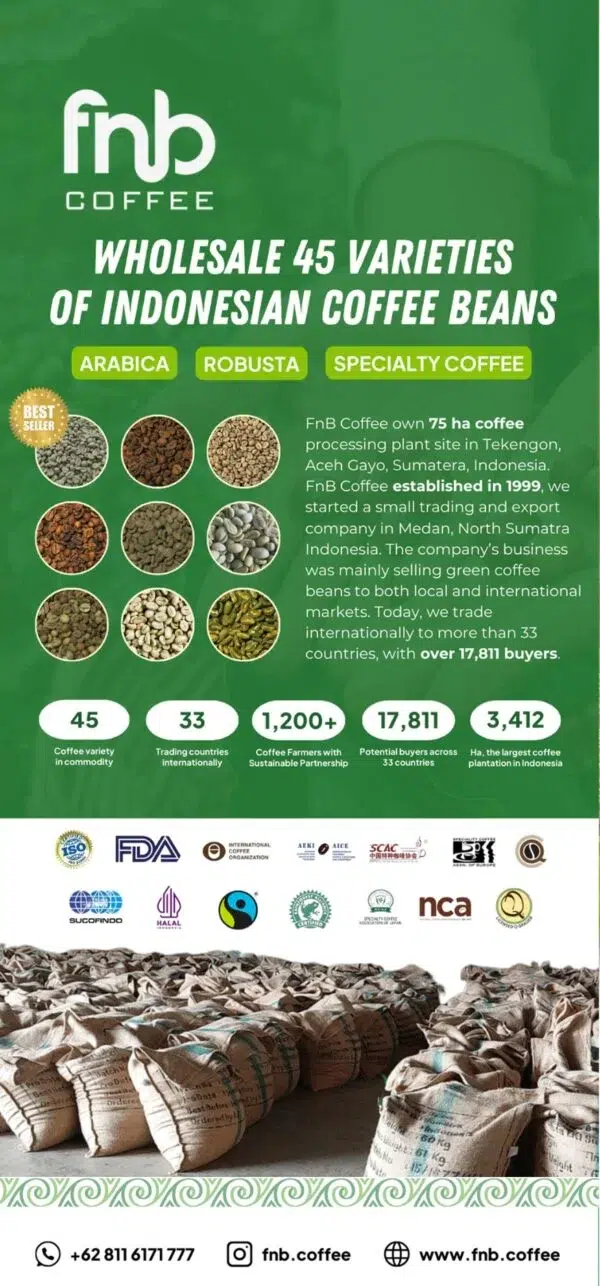
Indonesia is one of the largest coffee producers on earth, and Indonesia coffee export reaches roasters in every major market. If you want to bring that coffee into your own business, the question is not whether Indonesia can supply it, but who you export it through, and whether they can repeat the same quality order after order. FnB Coffee is an Indonesian green coffee supplier and exporter based at origin in Medan, exporting since 1999 and shipping a full range of origins direct from the source to buyers in more than 50 countries.
Indonesia Coffee Export at a Glance
Before you pick an exporter, it helps to know where Indonesian coffee already goes and why buyers keep coming back to it. Indonesia ships roughly half a million tons of coffee a year: according to Statistics Indonesia (BPS) data reported by Databoks, export volume reached about 508 thousand tons in 2025, up more than 60% on the year before, and coffee was the country’s highest-value agricultural export that year.
Top markets for Indonesian coffee
The buyers are spread across every region, which is one reason Indonesian green coffee moves easily through most ports:
- United States – the largest single destination by volume. American roasters value Sumatra and Gayo lots for body and for anchoring espresso and dark roast blends.
- Egypt and the Middle East – strong demand for full-bodied Robusta and Arabica, with Egypt acting as a trading hub for the wider region.
- Malaysia, the Philippines and other ASEAN markets – close neighbours with a shared coffee culture, buying both green beans and soluble coffee.
- Japan – a quality-driven market with steady demand for clean, well-graded Arabica.
- India – a producer in its own right that still imports Indonesian beans to widen its blend profiles.
- European Union – Italy, Germany and Spain in particular source Indonesian Robusta for espresso blends and instant coffee, and Indonesian Arabica for single-origin offerings.
Why importers choose Indonesian coffee
Three things keep Indonesian coffee on buyers’ lists. First, the flavor: wet-hulled Sumatra Arabica is earthy, heavy-bodied and low in acidity, while Java, Bali, Toraja and Flores add cleaner, sweeter profiles, so one country covers a wide range of cup styles. Second, processing variety: washed, natural, honey and wine-process lots all come out of the same origin, which is rare. Third, availability across Arabica, Robusta and specialty, so a blend house and a specialty roaster can both fill their needs from one exporter.
What FnB Coffee Exports
The strength of working with us is choice. We export a wide range of Indonesian green coffee, so you can source almost anything the country grows from a single exporter. Here is a selection of what we ship, across Arabica, Robusta, and specialty, in washed, natural, honey, and wine styles:
| Coffee | Type | Origin | Price (USD/kg) |
|---|---|---|---|
| Aceh Gayo | Arabica | Sumatra, Gayo | $19 to $34 |
| Gayo Longberry | Arabica | Sumatra, Gayo | $36 to $58 |
| Sumatra Mandheling | Arabica | Sumatra | $13 to $37 |
| Golden Mandheling | Arabica | Sumatra | $19 to $34 |
| Organic Mandheling | Arabica, organic | Sumatra | $21 to $35 |
| Sumatra Lintong | Arabica | Sumatra | $20 to $34 |
| Sumatra Peaberry | Arabica, peaberry | Sumatra | $33 to $54 |
| Java Ijen | Arabica | Java | $20 to $34 |
| Java Preanger | Arabica | Java | $20 to $34 |
| Toraja | Arabica | Sulawesi | $19 to $35 |
| Kalosi | Arabica | Sulawesi | $19 to $34 |
| Bali Kintamani | Arabica | Bali | $21 to $36 |
| Flores | Arabica | Flores | $20 to $34 |
| Abyssinian | Arabica | Indonesia | $34 to $56 |
| Gayo Honey | Arabica, honey | Sumatra, Gayo | $33 to $54 |
| Gayo Natural | Arabica, natural | Sumatra, Gayo | $33 to $54 |
| Gayo Wine | Arabica, wine | Sumatra, Gayo | $32 to $53 |
| Java Honey | Arabica, honey | Java | $33 to $54 |
| Bali Natural | Arabica, natural | Bali | $32 to $53 |
| Mandheling Wine | Arabica, wine | Sumatra | $32 to $53 |
| Lampung | Robusta | Sumatra, Lampung | $10 to $20 |
| Sidikalang | Robusta | Sumatra | $11 to $22 |
| Sumatra Robusta | Robusta | Sumatra | $11 to $23 |
| Bali Kintamani Robusta | Robusta | Bali | $14 to $25 |
| Kopi Luwak | Specialty, rare | Sumatra | $50 to $78 |
| Gayo Screen 20 Up | Specialty grade | Sumatra, Gayo | $23 to $38 |
Note: these are per-kilogram retail ranges that move with weight, grade, and the market, so treat them as a guide rather than a fixed export quote. Wholesale pricing per metric ton starts at 9 MT per order. This is a selection too; our full catalog carries more origins, processed lots, and grades. For a current price on the exact coffee and volume you want, ask for our wholesale price list or request a sample.
How FnB Handles Export
Exporting coffee well is about more than having beans. It is about getting them to your port cleanly, consistently, and with the paperwork in order. We are based at origin in Medan, North Sumatra, with our own warehouse, a 2,621-hectare estate, and a network of around 1,200 partner farmers, so we buy and grade at the source rather than through a chain of middlemen. That direct position is what lets us hold quality steady: the Gayo or Mandheling you approved in your last order should taste the same in the next one.
From contract to container
- Grading: every lot is cupped and graded to SNI and specialty standards, from Grade 1 to Grade 6 depending on what you order, with documented moisture and defect specs.
- Samples: you can cup and approve the coffee before you commit to a full order.
- Volumes: wholesale green coffee pricing applies from 9 metric tons per order, for LCL or full container loads; smaller quantities are available at retail rates.
- Shipping terms: FOB Belawan or any Indonesian port, with CIF on request.
- Lead time: stock is held in our Medan warehouse, and shipment normally follows at least two weeks after the contract is signed.
- Documents: our in-house EXIM team prepares the phytosanitary certificate, certificate of origin, customs clearance and quality inspection reports.
Export rules and paperwork to keep in mind
Two things have changed the export picture for Indonesian coffee buyers recently. Import tariffs in some major markets, including the United States, have shifted more than once and directly affect landed cost, so it pays to confirm the current rate for your HS code before you fix a price.
In the European Union, the deforestation regulation (EUDR) requires importers to show that coffee was not grown on recently deforested land, which means traceability back to the farm matters more than it used to. Sourcing from an exporter that buys and grades at origin, with its own estate and a known supply base, makes that documentation far easier to assemble. If you are new to the process, our guide on how to import coffee from Indonesia walks through the steps on the buyer’s side, and our overview of working with an Indonesian coffee exporter covers what to ask before you sign.
Why Choose FnB Coffee for Your Indonesia Coffee Export
What makes us a strong export partner is range plus reach from a single source. Most exporters give you a handful of origins, but as the table shows we carry the breadth of Indonesian coffee, Arabica, Robusta, and specialty, in every major processing style, which means you can consolidate your Indonesian sourcing with one exporter rather than juggling several. Behind that range sits a business exporting since 1999 and a base at origin in North Sumatra, so the coffee is bought, graded, and shipped by the same team from start to finish. You get one point of contact, one grading standard on every lot, cupping and samples on request, and export handled end to end.
Frequently Asked Questions
What coffee does FnB Coffee export?
A full range of Indonesian green coffee: Arabica from Sumatra, Java, Bali, Sulawesi, and Flores, Robusta from Lampung, Sumatra, and Bali, plus specialty lots such as Kopi Luwak, Peaberry, and Gayo Longberry, in washed, natural, honey, and wine styles.
Which countries import the most Indonesian coffee?
The United States is the largest destination, followed by markets such as Egypt, Malaysia, Japan, India, and the European Union, especially Italy, Germany, and Spain. Demand covers both Arabica for single-origin roasting and Robusta for espresso and instant blends.
What is the minimum order for exporting coffee from Indonesia with FnB Coffee?
Wholesale pricing starts at 9 metric tons per order. Smaller quantities are available at retail rates, with a USD 100 minimum order, which suits trial purchases before you scale up.
Do you ship worldwide?
Yes. We export to buyers in more than 50 countries, FOB Belawan or any Indonesian port, with CIF available on request and the export paperwork prepared by our own EXIM team.
Can I order a sample before exporting a full volume?
Yes. We provide two 350 g samples so you can cup and approve the coffee before committing to a contract. See our sample policy for the details on freight for first-time buyers.
Conclusion
Indonesia coffee export is a large, well-established trade, and the coffee itself is rarely the problem. The difference between a smooth first container and a stressful one is the exporter: whether they grade consistently, document every lot, and ship on the date they promised. If you want the full spread of Indonesian Arabica, Robusta, and specialty coffee from one account, graded at origin and shipped with the paperwork done for you, FnB Coffee is built for that.
Ready to export Indonesian green coffee for your roastery or import business? Browse our Indonesian green coffee beans, check our wholesale terms, then contact us to request a sample or a quote.

I write for FnB Coffee, and I always have a passion for writing anything that can presents Indonesian Coffee Diversity. From the highlands of Sumatra to the volcanic soils of Java and the unique flavours of Sulawesi, I hope to tell a plethora of stories to showcase the history, customs, and creativity behind Indonesia’s coffee culture. From the cultivation side of farming and sustainability, to brewing and flavor notes, my articles dive into everything to find out what makes Indonesian coffee truly one of a kind.